A second-semester nursing student is standing outside a door marked Simulation Suite with four classmates. Through the window she can see a hospital bed, a monitor on a wall arm, and a figure under a blanket that is very obviously not a person. Someone has told her the session is "not graded." Someone else has told her that a facilitator watches everything through one-way glass and writes it down. Nobody has told her what actually happens between walking in and walking out.
That gap matters. Simulation works as educational time only when learners engage with it as if it were real, and people do not engage with something they are braced against. The evidence for what simulation delivers when it is run well is in our article on why simulation builds confident clinicians; this article is about what "run well" looks like from the inside on your first day.
It walks through the day in order: the prebrief, the room, how a scenario unfolds, what the facilitator is watching for, the debrief that takes most of the time, how performance is recorded, and why a working nurse may be back in the same lab for competency validation years later.
Nothing clinical happens in the first part of a simulation day. You sit in a briefing room with the facilitator and your small group, and the facilitator does three things: orients you to the environment, states the learning objectives, and sets the terms of engagement. The INACSL Healthcare Simulation Standards of Best Practice treat prebriefing as a standard in its own right, because the quality of the scenario and the debrief both depend on it.
The orientation is practical: where the equipment is, what the manikin can and cannot do, how to reach the facilitator if you need something the room does not have, and how the session will be paused if needed. The objectives are usually about process rather than a single right answer: recognizing that a situation is changing, communicating within the team, escalating appropriately. If you know the objectives, you know what the day is for.
The terms of engagement are where first-timers either relax or fail to. The facilitator will ask you to enter what simulation educators call the fiction contract: an explicit agreement that you will treat the scenario as real, and in return the facilitator will make it as realistic as the equipment allows and will never trick you. A manikin cannot sweat or grimace. The contract means you act as though it could, and the facilitator does not hold the manikin's limits against you.
This is what psychological safety means in a simulation lab. It is not a promise that nothing will be hard or evaluated. It is an assurance about what will and will not be judged: your reasoning and teamwork will be discussed in detail, your character will not, and what happens in the room stays in the room unless a genuine safety issue emerges. Ask which parts of the session are formative (for learning) and which, if any, are summative (counting toward a grade or sign-off).
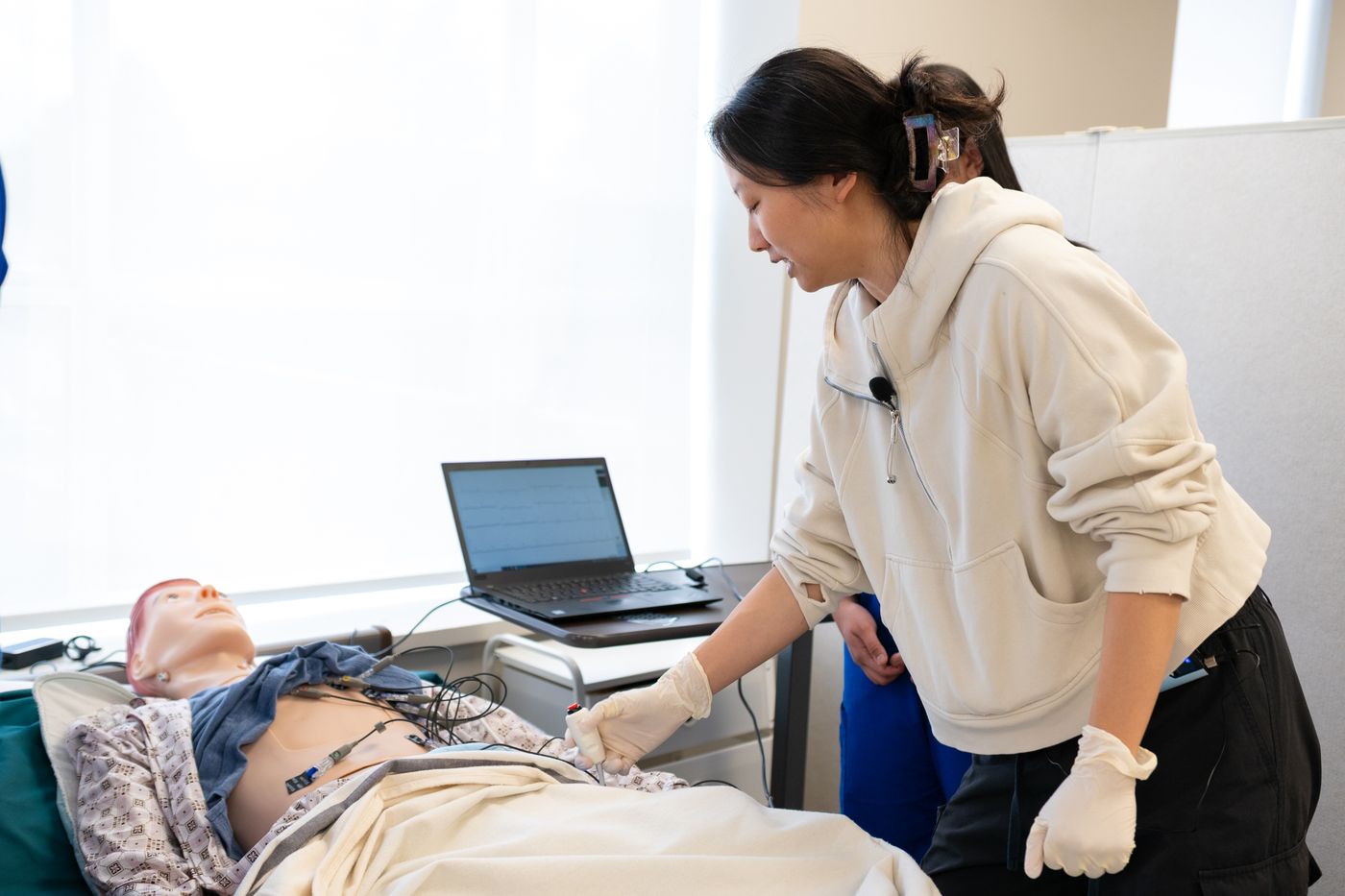
A modern simulation room is built to look like the clinical area it represents, and the bed, the supply cart and the call bell are real. The difference is what is in the bed and who is behind the wall.
The patient is usually a high-fidelity manikin: a full-body simulator with a pulse you can feel, chest movement, heart and lung sounds, eyes that open and close, and a voice, which is a facilitator's or technician's through a speaker. Its monitor shows the kind of display you would see on a unit, driven from the control room. Some scenarios use a standardized patient instead: a trained person portraying a patient or family member to a script, the better choice when the objective is communication or a difficult conversation; the Association of Standardized Patient Educators publishes standards of best practice for those portrayals. Our guide to simulation fidelity and what the money buys explains why a lower-tech setup is sometimes the right one.
The control room is behind glass or a camera wall. In it a simulation technician runs the manikin and the monitor from a computer, the facilitator watches, and a recording is usually made for the debrief. Nothing in the control room is secret, and most programs will show it to you during orientation. Knowing that a person is behind every change on the monitor turns the manikin from an unpredictable object into a colleague's teaching tool.
A scenario starts with a handoff. A facilitator or a recorded voice gives you the patient's story in the form you would receive it on a unit, and then the room is yours. Most scenarios run with a small team and assigned roles: someone leads, someone is at the bedside, someone documents, someone is the runner who fetches help and supplies. The roles rotate so that everyone leads at least once.
Every scenario is scripted around a change. The patient is stable, and then something on the monitor, in the manikin's speech, or in the standardized patient's behavior shifts. That cue is deliberate and timed, usually released once the team has completed a first assessment. The objective is to see whether the change is noticed, how quickly it is communicated, and what the team does with it.
What the team does with it almost always includes calling for help. Scenarios are designed so that the correct response involves escalating to a provider, a rapid response team, or a charge nurse, and the person on the other end of the phone is a facilitator playing that role. Learners are often surprised by how much of the scenario turns out to be about communication: the handoff received, the call made, and how the team was told what was happening. Scenarios end on a signal from the control room, not when the team feels finished.
The facilitator's role is shaped by the INACSL Healthcare Simulation Standards of Best Practice, which include separate standards on prebriefing, facilitation, the debriefing process, and the evaluation of learning and performance. A facilitator working to those standards is not a silent examiner: they manage the flow of the scenario, release cues at the right moments, and gather specific observations to bring to the debrief.
What they note is behavior tied to the objectives, not a tally of everything you did. If the objective is recognizing change, they note when the change on the monitor was first commented on and by whom. If it is communication, whether the handoff to the arriving provider was structured and complete. Timestamps from the recording help, because a debrief anchored to a specific moment is far more useful than "you seemed a bit slow."
The facilitator is also watching for signs that the fiction contract is breaking: laughter at the manikin, a learner stepping out of role, a team freezing entirely. Facilitation includes rescuing a drifting scenario, sometimes by voicing the patient, sometimes by sending in a "colleague" with a nudge. That is a normal part of the job, not a failure.
The debrief usually lasts longer than the scenario, and in many programs much longer. That surprises first-timers who assume the manikin is the main event. The INACSL standards treat the debriefing process as the phase where an experience becomes learning, and the NCSBN National Simulation Study ran its simulation with trained facilitators and structured debriefing. Simulation without debriefing is an exercise; with debriefing it is education.
A structured debrief has a shape: reactions first (what was that like, what stood out), then analysis, where the facilitator uses the observations they gathered to explore the reasoning behind what happened through questions rather than corrections, then a summary in which each learner names what they will do differently.
You will be asked to explain your thinking, not just your actions. The facilitator's job in analysis is to surface the frame that produced the action: what you noticed, what you assumed, what you were trying to achieve. Correcting an action fixes one scenario; correcting the frame changes what you will do on a unit next year.
Programs differ here, and the honest answer is: ask yours. Most simulation sessions in a nursing curriculum are formative, meaning the record is feedback and a reflection, not a grade. Some are summative: an end-of-course scenario assessed against a rubric, or a competency check for a specific skill. The INACSL standard on the evaluation of learning and performance asks programs to decide in advance which kind a session is, use tools that fit, and tell the learners.
When a rubric is used, it is usually behavioral and tied to the stated objectives: did the team recognize the change, communicate it, escalate. Rubrics may be completed during the scenario, checked against the recording, and shared in the debrief. Recordings are governed by the program's policy on retention and access; most are kept for a limited period for educational review and are not part of your permanent record. The Society for Simulation in Healthcare also offers the Certified Healthcare Simulation Educator credential, a signal that a facilitator has been trained in prebriefing, facilitation and debriefing.
Every simulation educator hears the same fears. "I will freeze." Some learners do, briefly; a nudge from the control room or a teammate gets things moving, and the freeze becomes a useful discussion in the debrief. "I will look stupid in front of my classmates." They are worrying about the same thing, and the prebrief's agreements exist so that the discussion is about reasoning, not about anyone as a person. "The manikin is unrealistic, so it does not count." The fiction contract handles this: you agree to act as if, and the facilitator agrees not to penalize the manikin's limits.
What actually happens, for most first-timers, is a scenario that feels far more real than expected, a call for help, an end signal that comes sooner than they thought, and a debrief that teaches them more about how they think under pressure than any lecture has. Then they ask when they can do it again.
Working nurses meet the simulation lab again from the other side. Facilities use scenario-based simulation to validate competencies at orientation, at annual review, and when a unit takes on a new patient population or new equipment. Accrediting bodies such as The Joint Commission expect facilities to assess and document staff competence, and a scenario observed against a rubric is a better test of clinical judgment than a written quiz or a signature on a checklist.
The process is the same, with the emphasis shifted. The prebrief still sets the fiction contract, and psychological safety matters even more when the learners are experienced staff who may feel they have something to lose. The scenario is built around the competency being validated, the debrief is still where the learning happens, and the record is a documented validation rather than a reflection. Facilities that skip the debrief for throughput get a signature and lose the learning; the case for doing it properly is in our article on the practice-readiness gap.
The habits formed in a student lab, entering the fiction contract, saying your reasoning aloud, escalating early, treating the debrief as the main event, are the habits that make an orientation scenario at your first employer a formality rather than a fright.
Is a simulation session graded? It depends on the program and the session. Most simulation in a nursing curriculum is formative: the record is feedback and your own reflection, not a grade. Some sessions are summative, assessed against a behavioral rubric tied to the stated objectives. The INACSL Healthcare Simulation Standards of Best Practice ask programs to decide this in advance and tell learners, so ask if it has not been stated.
What happens if I freeze during a scenario? Freezing briefly in a first scenario is common enough that facilitators plan for it. A cue from the control room, a prompt from the patient's voice, or a teammate's question usually restarts the action, and the moment becomes one of the most useful topics in the debrief. Nobody fails a formative session for freezing; the point is to find out what you were thinking.
Will the recording be used against me? Recordings exist so the debrief can point to a specific moment rather than a memory. Programs set their own policies on how long recordings are kept and who can view them, and a good program will show you that policy on request. In most programs recordings are held briefly for educational review and are not part of your permanent academic record.
Do working nurses use simulation labs too? Yes. Facilities use scenario-based simulation for orientation, annual competency validation, and preparation when a unit takes on new equipment or a new patient population. The process is the same one students experience: prebrief, scenario, debrief, and a record, with the record documenting a validated competency rather than a reflection. Wahero delivers this training in its own lab and on site at facilities across Texas.
The best way to stop worrying about a simulation lab is to walk through one. Wahero's simulation lab runs scenario-based training for students, new graduates and working nurses, built to the INACSL Healthcare Simulation Standards of Best Practice, and brings the same scenarios to Texas facilities that want competency validation done properly.
Educational content only
This material is published by Wahero Health Institute for professional education and is not individual medical advice, a care protocol, or a substitute for clinical judgment. Always follow your facility's policies, your state's nurse practice act, and your own scope of practice, and confirm medication doses against a current authoritative reference before administration. See our Terms of Use.