A new graduate starts on your medical-surgical unit on a Monday. She passed the NCLEX on her first attempt, her transcript is strong, and she interviewed well. By the end of her second week she is managing five patients, and on the Thursday of that week she misses the early signs of a patient sliding toward sepsis, not because she does not know the signs, but because knowing them in a test question and recognising them across five competing demands at 3pm are two different skills, and nobody built the second one.
Nothing in that is a criticism of the nurse or her school. She is exactly as prepared as the system produced her to be. The system was never designed to produce a bedside-ready clinician on day one. It was designed to produce a safe entry-level candidate for licensure, a narrower and more honest promise than most hiring managers assume they are buying.
That distance, between what a license certifies and what a functioning unit needs, is the practice-readiness gap. This article is for the people who inherit it: the directors of nursing, unit managers and educators who discover, usually in the first ninety days, that the gap is now their operating problem. What follows is what the gap actually is, the evidence that it is widening, why it lands on the employer rather than the school, and the four levers that reliably close it.
The license and the job are not the same thing, and the license never claimed to be. The NCLEX examines whether a candidate can practise safely at the level of a novice, under supervision, without endangering a patient. That is its entire remit. It does not certify speed, the ability to hold five deteriorating situations in working memory at once, or the clinical judgement that comes only from having seen a pattern before.
Patricia Benner's foundational work on skill acquisition in nursing named this decades ago. Benner described a progression from novice to expert in which the newest practitioners rely on explicit rules because they have no store of experience, and only later develop the pattern recognition that lets an experienced nurse walk into a room and know something is wrong before the numbers say so. A new graduate is, by definition, a novice on that scale. No examination can move a person up it. Only time and structured experience can.
So the gap is not a defect. It is the predictable space between two legitimate but different standards: minimum competence for licensure, and functional competence for a specific unit with its own patients, equipment, protocols and pace. The mistake facilities make is treating that space as something that should not exist, rather than something that must be deliberately bridged.
The core confusion. A nursing license certifies safe entry-level practice under supervision. It was never a certificate of readiness to run your unit unsupervised. Every onboarding failure that starts with "but they were licensed" starts with that mistaken assumption.
Concretely, the gap shows up across a handful of domains where school emphasises breadth and the bedside demands depth. The illustration below is conceptual, but it captures the shape every unit educator recognises: knowledge transfers well, and the organising skills a unit runs on barely transfer at all.
This is not a new problem, but there is good reason to believe it is a growing one, and the evidence comes from the bodies whose job it is to watch. The National Council of State Boards of Nursing (NCSBN) has studied the transition into practice for years, and its landmark transition-to-practice study made the central point plainly: new graduates who go through a structured transition programme make fewer practice errors and report higher competence than those left to sink or swim. That finding is the whole argument for treating readiness as buildable rather than innate.
Several forces have widened the space that transition must cover. The pandemic years disrupted clinical placements, so a cohort of graduates entered practice with fewer hours of hands-on patient contact. Patient acuity on general units has risen, meaning the floor a new nurse walks onto is more complex than the same floor a decade ago. And the experienced nurses who used to absorb the training load informally, quietly mentoring the new person over months, have been leaving, which removes the invisible scaffolding that closed the gap without anyone naming it.
Put those together and the gap is under pressure from both ends: graduates arriving with less bedside exposure, onto units that are more demanding and less able to teach informally. That is why a problem facilities managed for years by goodwill has recently started to show up as turnover and safety events instead.
The scaffolding that disappeared. For a generation the gap was closed invisibly, by senior nurses mentoring juniors in the margins of a shift. When those nurses leave, the gap does not shrink. It simply becomes visible, because nothing structured was ever built to replace what they were doing for free.
It is tempting, and common, to blame nursing programmes. The complaint that "schools do not prepare them anymore" is a fixture of every nursing leadership forum. It is also a dead end, for a simple reason: even a perfect programme cannot close this gap, because the gap is unit-specific by nature.
No school can teach a new nurse your electronic health record, your escalation protocol, your medication formulary, your charge nurse's expectations, or the rhythm of your patient population. Those are learnable only where they live, on your unit, after hire. The general portion of readiness has already been delivered by the time the license is granted; the portion that remains is, definitionally, the employer's to build. This is the same logic that makes onboarding, not recruitment, the real determinant of whether a hire succeeds, a point we develop in our guide to the new graduate's first year.
There is also a financial reason the employer cannot outsource this. The cost of the gap is paid on the unit, in turnover, overtime, error remediation and the quiet tax of experienced nurses covering for an underprepared colleague. When a new graduate leaves in the first year, the replacement cost is substantial, and it recurs, because the next hire arrives into the same unbridged gap. We break that number down in our analysis of what nurse turnover actually costs a facility. The organisation paying the cost is the one with both the responsibility and the incentive to fix it.
The good news is that this is a solved problem in the sense that the interventions are known, evidenced and repeatable. There are four, and they work best stacked rather than chosen between. Think of them less as a menu and more as a sequence.
A nurse residency is the frame that holds the other three levers. It is a defined programme, typically running over the first six to twelve months, that pairs clinical work with scheduled learning, reflection and support. The NCSBN transition-to-practice model exists precisely because the evidence favours structure over improvisation. A residency turns the first year from an accident that happens to a new nurse into a curriculum delivered to her, and gives the facility something concrete to measure and improve rather than a vague hope that people will "settle in".
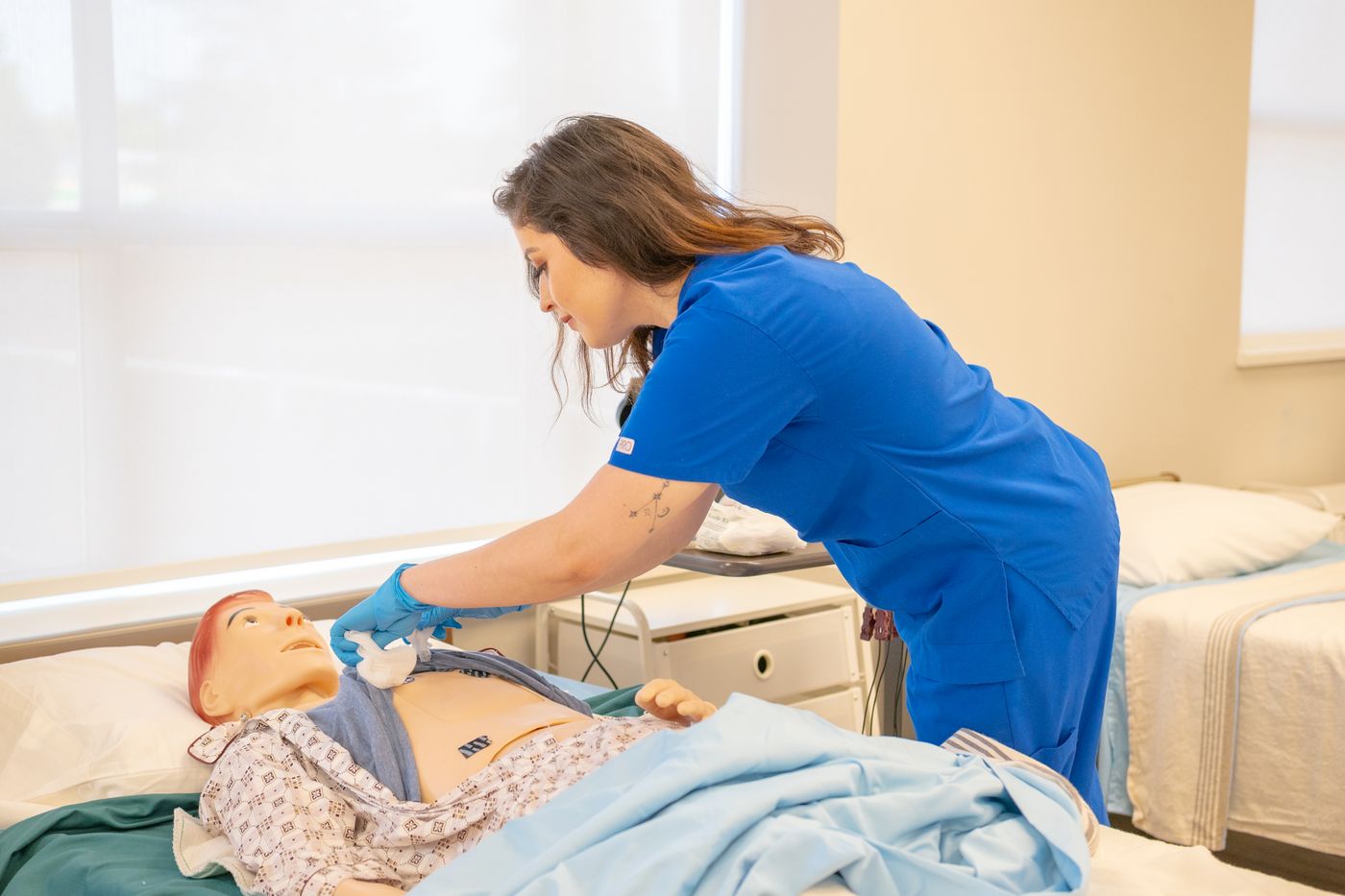
Simulation is how a new nurse accumulates pattern recognition without a real patient paying for the learning curve. In a simulated deterioration the nurse can miss the early signs, debrief on why, and try again next week, which is exactly the repetition Benner's model says converts rule-following into judgement. The NCSBN National Simulation Study supported substituting quality simulation for a meaningful portion of traditional clinical hours, which tells you the profession's own regulators regard well-run simulation as serious clinical learning. The debrief is where the learning lives, which is why the pedagogy matters as much as the manikin. We describe how we run this in our simulation lab, and the wider case in how simulation builds confident clinicians.
A preceptor is the experienced nurse who guides the new one through real shifts. The lever fails in one common way: a facility names a preceptor without preparing her. Being an excellent clinician does not make someone an effective teacher, and an unprepared preceptor tends either to do the task herself because it is faster, or to leave the new nurse to flounder. A trained preceptor knows how to hand over responsibility in graded steps, to question rather than tell, and to give feedback that builds rather than deflates. Preceptor development is the cheapest high-leverage investment on this list, because it multiplies across every new hire that preceptor ever supports.
The final lever answers a question the other three leave open: how do you know the gap has actually closed? Competency validation is the deliberate observation and documentation of a nurse performing to a defined standard, rather than an assumption that time served equals competence achieved. It protects the patient, the nurse handed responsibility she may not be ready for, and the facility that needs a defensible record. Done well it is specific and observed, not a checklist signed at a desk. We set out how to build one in our guide to building a competency validation program.
The reason to stack these levers rather than pick one is that together they compress the time to functional competence. Left alone, a new nurse usually still gets there, because people learn from experience whether or not anyone organises it. The problem is that the unstructured route is slower, more variable, and far more likely to end in a resignation first. A structured route does not change the destination. It changes the slope and the drop-out rate.
That earlier rise is not a soft benefit. Every week a new nurse spends below functional competence is a week another nurse is partly covering for her, a week of higher error risk, and a week closer to the point where she decides the job is not survivable. Compressing that period is at once a safety, retention and productivity intervention, which is why the return on a well-run transition programme is easier to defend than most training spend. We work through that calculation in measuring the ROI of clinical training.
A facility with a large, well-funded education department can build all four levers internally. Most cannot, at least not all at once, and the honest answer for many units is a hybrid: keep preceptorship in-house where it belongs, and bring in outside capacity for the parts that need specialised facilitation, equipment or simply time your charge nurses do not have. Simulation is the clearest example, because running it well needs both the manikins and a facilitator trained in debriefing.
This is the reasoning behind our mobile clinical education model, which brings the equipment and the facilitator to your site rather than sending your nurses away for days you cannot spare. The build-versus-buy choice is not ideological; it is a question of where your constraint actually sits, and we lay out the trade-offs in our facility leader's guide to building and buying clinical workforce training. Whichever route you choose, the levers are the same. Only the supplier changes.
The decision that matters. The question is never whether to close the practice-readiness gap. The unit closes it either way, slowly and expensively by attrition, or quickly and deliberately by design. The only real choice is which of those two you are paying for.
No, and treating it that way wastes the only leverage you have. A nursing programme delivers the general, transferable portion of readiness and certifies safe entry-level practice. The remaining portion is unit-specific: your record system, your protocols, your patient population and your pace. That cannot be taught anywhere but on your unit, after hire, which makes it the employer's to build regardless of how good the school was.
The evidence points that way. The NCSBN transition-to-practice work found that new nurses who complete a structured transition programme report higher competence and make fewer practice errors than those who do not. The mechanism is straightforward: a residency replaces an accidental first year with a deliberate curriculum, and it shortens the vulnerable early period where first-year resignations concentrate.
It replaces a portion of it, and the profession's own regulators accept this. The NCSBN National Simulation Study supported substituting well-run simulation for a meaningful share of traditional clinical hours. Simulation lets a nurse encounter a rare or dangerous scenario, miss it safely, debrief, and repeat, which is how pattern recognition is built. It supplements real patient care rather than eliminating it.
Because assigning a preceptor and preparing one are different acts. An excellent clinician is not automatically an effective teacher, and an untrained preceptor often either takes over the task or leaves the new nurse to struggle. Preceptor development, teaching graded handover, questioning and constructive feedback, is what turns the assignment into a lever, and it pays back across every hire that preceptor ever supports.
Through competency validation: direct, documented observation of the nurse performing to a defined standard, rather than an assumption that time served equals competence achieved. It is the gate that confirms readiness before a nurse carries a full independent assignment, and it protects the patient, the nurse and the facility at the same time.
Your unit is already paying to close the practice-readiness gap. The only question is whether you are paying the slow, expensive price of attrition, or the deliberate price of a programme that gets new nurses to competence sooner and keeps them. Wahero brings the simulation, the facilitation and the competency framework to your facility, and works with your preceptors rather than around them.