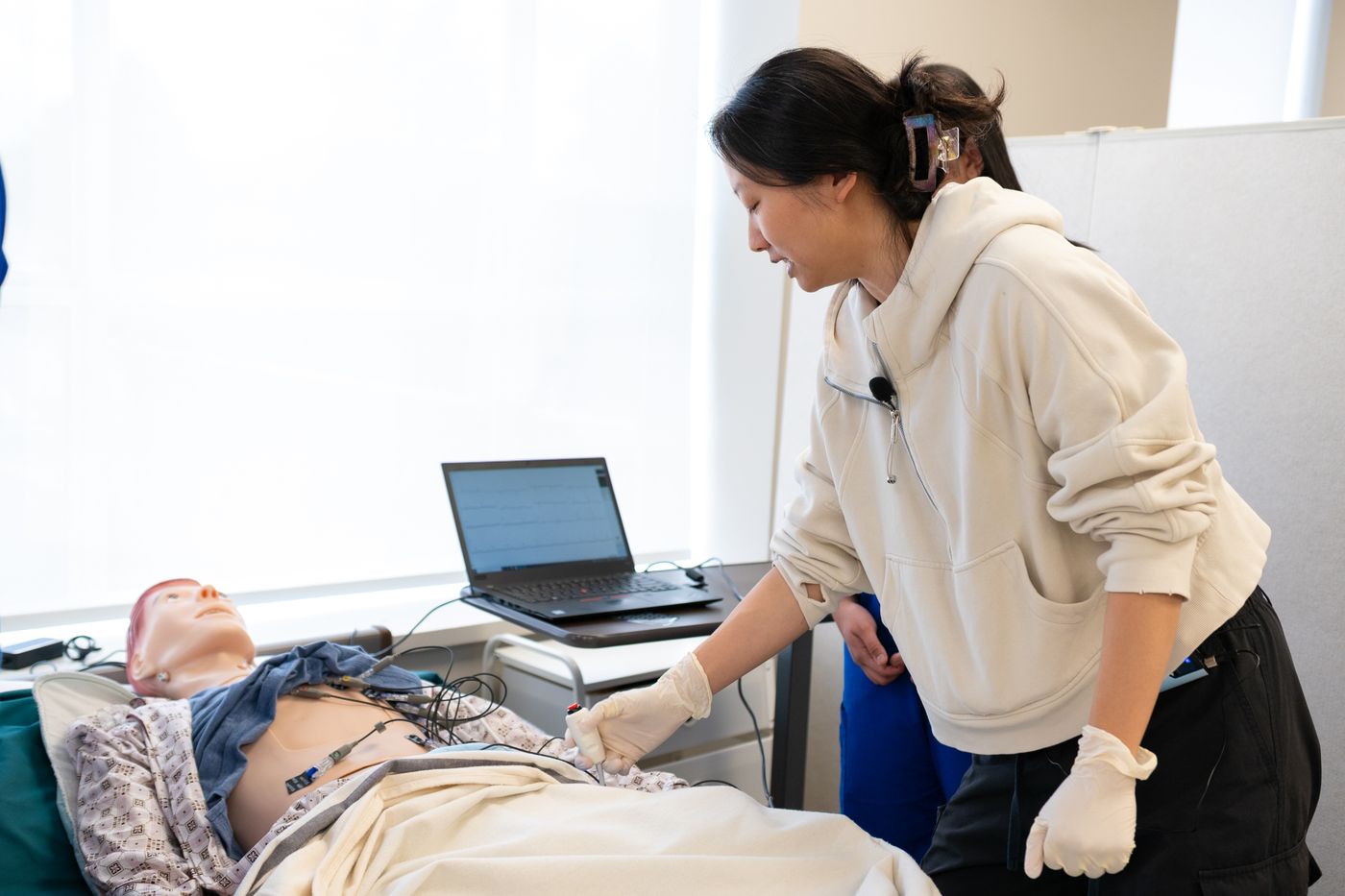
Picture a new nurse's first deteriorating patient. The blood pressure is sliding, the level of consciousness is changing, and a provider on the phone is asking pointed questions. No textbook fully prepares someone for that moment. A well-run simulation lab, however, can come remarkably close, and it can do it a dozen times before the real moment ever arrives.
The stakes of getting this right are not academic. Clinical confidence, the earned kind built on rehearsed competence, shapes how quickly a nurse recognizes trouble, how decisively they escalate, and how safely they perform under pressure. Programs that leave confidence to chance produce graduates who freeze at exactly the moments that matter most.
This article explains what simulation-based education actually is, what the strongest evidence in nursing education says about it, why psychological safety and structured debriefing are the active ingredients, and how programs and hospitals can implement it well.
Simulation-based education is any structured learning activity that replaces or amplifies a real clinical experience with a guided, interactive substitute. The term covers a wide fidelity spectrum, and fidelity simply means how closely the experience reproduces the real thing along the dimensions that matter for the learning goal.
At the low end sit task trainers: an IV arm, an airway head, a suture pad. They isolate one psychomotor skill and make repetition cheap. In the middle are standardized patients, trained actors who bring communication, emotion, and unpredictability into the room. At the high end are full-body mannequins with palpable pulses, programmable heart and lung sounds, and monitors that respond in real time to what learners do, all run from a control room by an educator who can make the patient improve or crash on cue.
The common beginner mistake is equating high fidelity with high value. Fidelity is a tool, not a goal. A ten-dollar task trainer is the right choice for learning to anchor a vein; a high-fidelity deteriorating-patient scenario is the right choice for learning to recognize shock and escalate. Good educators match the fidelity to the objective, not to the budget line.
For years, the open question was whether simulation could stand in for traditional clinical hours or merely supplement them. The National Council of State Boards of Nursing (NCSBN) answered it with the National Simulation Study, a large, multi-site, randomized controlled study that followed nursing students across programs in the United States.
Students were assigned to complete their clinical education with traditional clinical hours, with 25 percent of those hours replaced by high-quality simulation, or with 50 percent replaced. The finding was striking: across clinical competency ratings, nursing knowledge assessments, and NCLEX pass rates, the three groups were equivalent. Substituting up to half of traditional clinical time with well-designed simulation produced graduates who were just as prepared, and the study followed them into their first six months of practice without finding meaningful differences.
The regulatory world responded. Many US boards of nursing now formally permit programs to substitute a portion of clinical hours with simulation, provided the simulation meets quality standards for trained faculty, theory-based debriefing, and realistic environments. That proviso matters as much as the permission: the study tested high-quality simulation, and its results belong only to programs that deliver it.
Ask educators why simulation works and the honest answer starts with a paradox: it works because learners are allowed to fail. In a real clinical setting, failure has a human cost, so students are supervised tightly, handed the routine tasks, and shielded from the very situations they most need to practice. Nobody lets a novice manage a deteriorating patient alone, which is precisely why so many new graduates meet their first one unprepared.
Simulation removes the cost of failure without removing the experience of it. A learner can miss the early signs of sepsis, watch the consequences unfold on the monitor, feel the genuine sting of it, and then be guided to see exactly where their reasoning diverged. That emotional engagement is not a side effect; memory research consistently finds that experiences with emotional weight and active decision-making are retained far better than passively received information.
For this to work, the environment must be psychologically safe. Learners take intellectual risks, commit to decisions, and expose their reasoning only when they trust that mistakes are treated as data rather than as verdicts. That is why reputable simulation programs open every session with an explicit agreement, often called the fiction contract: the educator commits to realism and respect, and learners commit to engaging as if the patient were real. Programs that use simulation to ambush or humiliate learners get silence and defensiveness, and the learning stops.
Here is the point most outsiders miss: the scenario is not the lesson. The scenario generates the raw material, and the structured debrief that follows is where raw material becomes clinical judgment. Simulation educators often spend as long in debrief as in the scenario itself, and the professional standards for simulation practice treat theory-based debriefing as a defining feature of quality, not an optional extra.
A structured debrief is not a critique session. The facilitator guides learners to reconstruct what happened, surface the reasoning behind each decision, and compare that reasoning against the clinical picture. Frameworks differ in the details, but the strong ones share a common move: instead of telling a learner what they did wrong, the facilitator asks what they saw, what they made of it, and what led them to act as they did. Faulty frames, not faulty people, are the target, because a corrected frame transfers to every future patient while a corrected action transfers to one.
The prebrief deserves equal respect. Before the scenario, learners are oriented to the environment, the equipment, and the objectives, and the psychological safety agreement is made explicit. Skipping the prebrief to save time is a false economy: disoriented learners spend the scenario decoding the room instead of the patient.
Confidence in a clinician is only valuable when it is calibrated, meaning it tracks actual competence. Simulation builds exactly this kind of confidence because it pairs performance with immediate, specific feedback. Learners discover both what they can do and what they cannot yet do, and both discoveries are safe to make.
Calibrated confidence pays off at the bedside in ways patients can feel. A nurse who has rehearsed a rapid response call speaks up earlier and more clearly. A nurse who has run a mock code knows where their hands go in the first sixty seconds. Hesitation, the silent tax that under-confidence levies on every escalation decision, shrinks with every rehearsed encounter. The nursing education literature consistently reports gains in self-confidence and reductions in anxiety following well-designed simulation, and repeated exposure appears central: the third deteriorating patient, even a simulated one, is met differently than the first.
Because the evidence belongs to high-quality simulation, it is worth being concrete about what quality means. Strong programs share a recognizable anatomy. Every scenario starts from explicit, measurable objectives, and every design choice serves them. Fidelity is matched to those objectives rather than maximized by default. Facilitators are trained in simulation pedagogy and debriefing, not simply drafted from the clinical schedule. The prebrief establishes safety and orientation, the scenario runs without mid-stream coaching so that decisions are genuinely the learners' own, and the debrief is structured, theory-based, and at least as long as the scenario.
Good design also means deliberate scenario progression. Learners meet a manageable challenge first, then variations that add complexity: the same septic patient, but now with a communication barrier, a distracting family member, or an equipment failure. This is deliberate practice applied to judgment, stretching one variable at a time instead of overwhelming every system at once.
Finally, quality programs evaluate. If a scenario is meant to improve escalation, the program checks whether learners escalate better afterward, in later scenarios and where possible in practice. Simulation that is never measured tends to drift into theater.
For nursing programs, the practical sequence is: invest in facilitator development before hardware, because a skilled debriefer with a mid-range mannequin outperforms an untrained one with a showpiece lab; align scenarios to the curriculum map so simulation reinforces what students are learning that term; and document quality practices carefully if you intend to use simulation toward clinical hour substitution, since boards of nursing that permit it expect the standards the NCSBN study relied on.
For hospitals, simulation is not just for students. In-situ simulation, run on the actual unit with the actual team, is one of the best tools available for probing systems: it reveals the missing drug in the crash cart, the confusing paging chain, and the door the code team cannot fit a stretcher through, all before a real patient pays for those discoveries. Regular mock codes, escalation drills, and onboarding scenarios for new graduates measurably tighten team performance and shorten the anxious first months of practice.
Neither setting requires building a lab from scratch. Our simulation lab runs scenario-based training for students and practicing clinicians, and our organizational training services bring mobile simulation directly to facilities that want the benefits without the capital project.
Does simulation really count toward clinical hours? In many US states, yes, within limits set by the board of nursing and contingent on quality standards such as trained facilitators and structured debriefing. Requirements vary by state, so programs should confirm the current rules with their own board before building substitution into the curriculum.
Is high-fidelity simulation always better? No. Fidelity should match the objective. Psychomotor skills like IV insertion are learned efficiently on simple task trainers, while clinical judgment and team communication justify high-fidelity scenarios. Paying for realism that the objective does not require adds cost without adding learning.
How is a debrief different from ordinary feedback? Feedback tells a learner what to change. A structured debrief uncovers why the learner acted as they did, then works on that underlying frame. Because the frame drives future decisions, correcting it transfers to situations the learner has never seen, which one-off feedback rarely does.
Can experienced nurses benefit, or is simulation for students? Experienced clinicians benefit substantially, particularly for high-acuity, low-frequency events like codes, malignant hyperthermia, or massive transfusion, where even veterans get few real repetitions. Team-based in-situ simulation is also the standard way to rehearse coordination across roles.
Evidence is only useful when someone puts it into practice. Wahero Health Institute runs scenario-based training in our simulation lab and brings mobile simulation to nursing programs and healthcare facilities across the region. If you want your students or your staff to meet their hardest moments in rehearsal first, we should talk.
Educational content only
This material is published by Wahero Health Institute for professional education and is not individual medical advice, a care protocol, or a substitute for clinical judgment. Always follow your facility's policies, your state's nurse practice act, and your own scope of practice, and confirm medication doses against a current authoritative reference before administration. See our Terms of Use.