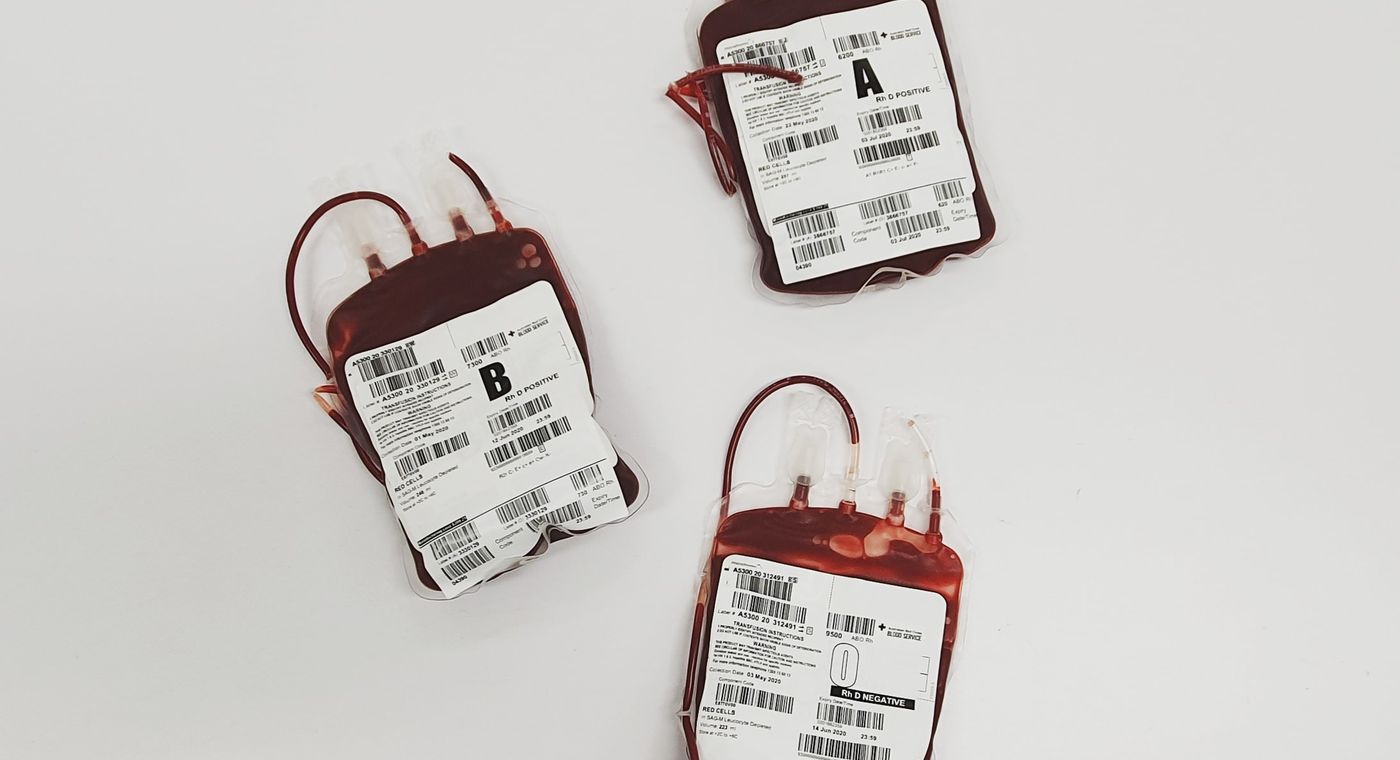
Fifteen minutes into a unit of red cells, a patient shivers and says they feel cold. That one observation is compatible with the most benign entry on the transfusion reaction list and with the most lethal one. Nothing in the first few minutes reliably separates them, and no amount of experience makes that ambiguity disappear.
This is not a gap in nursing education. It is the structural fact the whole architecture of transfusion safety is built around: because early presentations converge, the system cannot rely on anyone naming the reaction in the moment. It relies instead on controls placed before the first drop, and on a defined institutional response that does not require a diagnosis to begin.
This article is standards-anchored education, not bedside instruction. It covers how reactions are categorized by national surveillance definitions, why their early signs overlap, the immunology that makes ABO incompatibility a category of its own, why identification carries more safety weight than any other control, and how transfusion competency is taught and assessed. What it deliberately does not do is tell you what to do at a bedside in progress. That sequence belongs to your facility's transfusion policy.
Watch the companion teaching video, Blood Transfusion Reaction, from our educator's own channel, Spice to health$Nursevibes. The video walks through the reaction picture as students first meet it; the article below expands on it with the published standards that sit behind the practice.
Nurses often learn transfusion reactions as a list of things to recognize. That framing is understandable and slightly misleading. The categories in current use come from hemovigilance, the systematic surveillance of transfusion-related adverse events. In the United States the operative case definitions are published by the CDC in the National Healthcare Safety Network Hemovigilance Module, and the standards for practice come from AABB in its Standards for Blood Banks and Transfusion Services.
This matters because surveillance definitions are written to be applied after the event, by a transfusion service reviewing the whole record, so that events can be counted consistently across thousands of hospitals. The NHSN protocol even asks reviewers to grade imputability, the strength of the link between transfusion and event, on a scale from definite through probable and possible to doubtful and ruled out. A category is a conclusion reached retrospectively, not a decision made while a unit is running.
Read them that way and the nursing task becomes more honest. You are not being asked to classify. You are being asked to observe carefully, to document what you observed and when, and to trigger the institutional response your policy defines.
Six acute categories account for most of what is taught, and each is defined by its underlying mechanism rather than by how it looks.
Acute hemolytic transfusion reaction is immune destruction of transfused red cells, classically from ABO incompatibility, and it carries the highest potential for rapid harm. Febrile non-hemolytic transfusion reaction is the most common, attributed to recipient antibodies against donor leukocytes and to cytokines accumulated during storage. Its NHSN case definition centers on a fever with a rise of at least one degree Celsius from the pre-transfusion baseline, or on chills and rigors, a definition written for consistent counting rather than as a bedside threshold.
Allergic reactions span a wide severity range, from urticaria caused by IgE responses to soluble plasma proteins, through to anaphylaxis, a different order of event that can occur within minutes. Transfusion-associated circulatory overload, or TACO, is a volume and cardiac problem rather than an immune one: the circulation cannot accommodate the transfused volume at the rate delivered. Transfusion-related acute lung injury, or TRALI, is acute non-cardiogenic pulmonary edema associated with the transfusion. Septic transfusion reaction follows transfusion of a bacterially contaminated component, a risk associated particularly with platelets because they are stored at room temperature; AABB standards require methods to limit and detect bacterial contamination in platelets.
Two definitions have moved recently, which is itself worth teaching. TRALI was redefined by an international consensus panel in 2019 into type I and type II, replacing the 2004 Canadian Consensus Conference criteria, and the TACO surveillance definition was revised through a working party of the International Society of Blood Transfusion with AABB and the International Haemovigilance Network. Anyone teaching from a decade-old handout is teaching a superseded definition.
Look across the figure above and the difficulty becomes visible. Fever and chills appear in the febrile non-hemolytic, acute hemolytic and septic categories. Dyspnea appears in TACO, TRALI and anaphylaxis. Hypotension appears in acute hemolysis, anaphylaxis and sepsis. In the first fifteen minutes, very different mechanisms present through the same small vocabulary of signs.
There is a physiological reason for the convergence. Most of these mechanisms end in the same place: activation of innate immune and inflammatory pathways, cytokine release, and vasodilation. Whether the trigger is complement activation, donor leukocyte antibodies, bacterial endotoxin or an IgE-mediated response, the final common pathway looks similar from outside, because the body has a limited repertoire for expressing systemic inflammation.
The consequence is what every transfusion policy encodes: the response to a suspected reaction cannot be conditional on identifying which reaction it is. TACO and TRALI illustrate this. Both can present with respiratory distress within six hours, and telling them apart depends on volume status, cardiac markers, imaging and the clinical course, a determination made over hours by physician and laboratory, not in seconds at a bedside.
ABO incompatibility deserves separate treatment because its immunology is genuinely unlike the others, and understanding it explains why the whole safety system is weighted the way it is. Karl Landsteiner's discovery of the ABO system at the turn of the twentieth century established something unusual about these antigens: individuals carry preformed antibodies against the A or B antigens they lack, developed early in life through environmental exposure rather than through any prior transfusion. A person with group O blood carries both anti-A and anti-B without ever having been transfused. There is no sensitization step and no first exposure that is harmless.
These naturally occurring isohemagglutinins are predominantly IgM, a formidable activator of the classical complement pathway. When incompatible donor cells meet them, antibody binding drives the cascade to completion, forming the membrane attack complex that lyses red cells inside the vessel. The hemolysis is intravascular, immediate and antibody-driven, which is why it escalates faster than mechanisms depending on slow clearance by the spleen and liver.
What follows is systemic: free hemoglobin in plasma, inflammatory cytokines including tumor necrosis factor and interleukins, and activation of coagulation. This is the pathophysiology hemovigilance systems identify as the most serious consequence of transfusing the wrong unit, and it is why the FDA requires transfusion-related fatalities to be reported to its Center for Biologics Evaluation and Research.
Follow the mechanism back to its origin and an uncomfortable conclusion appears. An ABO-incompatible transfusion is rarely a failure of immunology or laboratory technique. It is a failure of identity: the right unit given to the wrong patient, or the right patient typed from a tube of somebody else's blood. The United Kingdom's Serious Hazards of Transfusion scheme gave the second failure its own permanent term, "wrong blood in tube," because the pattern recurred so reliably that it needed a name.
That is what makes bedside identification the highest-leverage control in the process. Every other safeguard operates on a sample or a unit whose identity a human being has already asserted. If the identity is wrong at the start, the laboratory performs a technically flawless crossmatch against the wrong person, and every downstream check passes.
The standards reflect this weighting explicitly. The Joint Commission's National Patient Safety Goals require two patient identifiers, and treat matching blood components to the patient as a distinct requirement rather than folding it into general identification, with the match confirmed through either a two-person verification process or an automated identification technology. AABB standards likewise require a defined process for confirming patient and component identity immediately before administration. Neither body writes your local procedure. Both require that one exists, that it is followed, and that it is documented.
Students frequently ask for the monitoring intervals: how soon after the start, how often after that, for how long. The honest answer is one of the most useful sentences in transfusion teaching. AABB standards require documented policies covering patient observation before, during and after transfusion. The intervals themselves, the responsible staff and the escalation pathway are set by your facility's policy, informed by the component manufacturer's instructions and by physician orders, and they vary legitimately between institutions.
Documentation is framed the same way. What was transfused, which unit, to whom, verified by whom, when it started, what was observed and when: these are what a hemovigilance review later depends on, and what a transfusion service cannot reconstruct if the record is thin. The FDA's regulations for blood establishments and transfusion services, in Title 21 of the Code of Federal Regulations, sit underneath all of it.
Learn the framework, then read your own policy before the shift on which you need it. "Know the principle, then find your local rule" is the same discipline we teach in recognizing patient deterioration early.
Transfusion is a standing example of a skill where knowledge and performance separate. Nurses who recite the categories flawlessly still miss steps in the identity check under time pressure, and that gap is what competency assessment exists to find.
Instruction usually runs in three layers. First, didactic: component types, immunology, categories and the regulatory framework. Second, procedural practice in the skills lab, where identity verification, equipment and documentation are performed against a checklist with an observer. Third, simulation, where a scenario runs in real time, often with a deliberate distraction or an ambiguous early sign, so the learner performs the process rather than describes it. The INACSL Healthcare Simulation Standards of Best Practice govern how those scenarios are designed, run and debriefed, and they place the debrief at the center of the learning.
Assessment is typically direct observation against a validated checklist, repeated at intervals defined by the facility's competency program. What a good assessor watches is narrower than students expect: whether the identity check was genuinely independent, whether baseline observations preceded the start, whether the learner triggered the institutional response without waiting for certainty, and whether the documentation would let somebody else reconstruct the timeline. Those behaviors, practiced until they survive distraction, are what our simulation lab scenarios exist to produce.
Strong programs rehearse the communication too. Reporting a suspected reaction is a structured handover under pressure, and if that structure is not yet automatic, our SBAR template gives you the scaffold.
Why can't nurses be taught to tell the reaction types apart early? Because the early signs genuinely do not separate them. Immune, inflammatory, circulatory and infectious mechanisms all express themselves through the same small set of signs in the first minutes, which is why standards frame a uniform institutional response and leave classification to later investigation.
Who actually decides which category a reaction was? The transfusion service with the treating physician, using the laboratory investigation, the clinical course and the documented timeline.
Why is ABO incompatibility singled out as the most serious? Because it needs no sensitization. Recipients carry preformed IgM antibodies against the ABO antigens they lack, IgM strongly activates the classical complement pathway, and the result is immediate intravascular hemolysis with systemic inflammatory and coagulation effects.
Where do the specific monitoring intervals come from? From your facility's transfusion policy, not from a national number that applies everywhere. AABB standards require that a documented process for observing the patient exists; the intervals, the staff responsible and the escalation pathway are institutional decisions.
Does this article replace my facility's transfusion protocol? No, and it is written so that it cannot. It contains no emergency algorithm and no dose-level guidance. It explains the categories, the immunology, the safety logic and how the skill is taught, so that when you read your own policy you understand why it says what it says.
Transfusion safety is not built from memorized lists. It is built from an identity check that survives a busy shift, an understanding of why that check carries so much weight, and the confidence to trigger a response before anyone can name what is happening. Wahero Health Institute runs transfusion safety education and reaction scenario simulation for nursing programs and hospital teams. Enrolled learners find scenario materials in the student portal, and upcoming sessions are listed on our live training page.
Educational content only
This material is published by Wahero Health Institute for professional education and is not individual medical advice, a care protocol, or a substitute for clinical judgment. Always follow your facility's policies, your state's nurse practice act, and your own scope of practice, and confirm medication doses against a current authoritative reference before administration. See our Terms of Use.