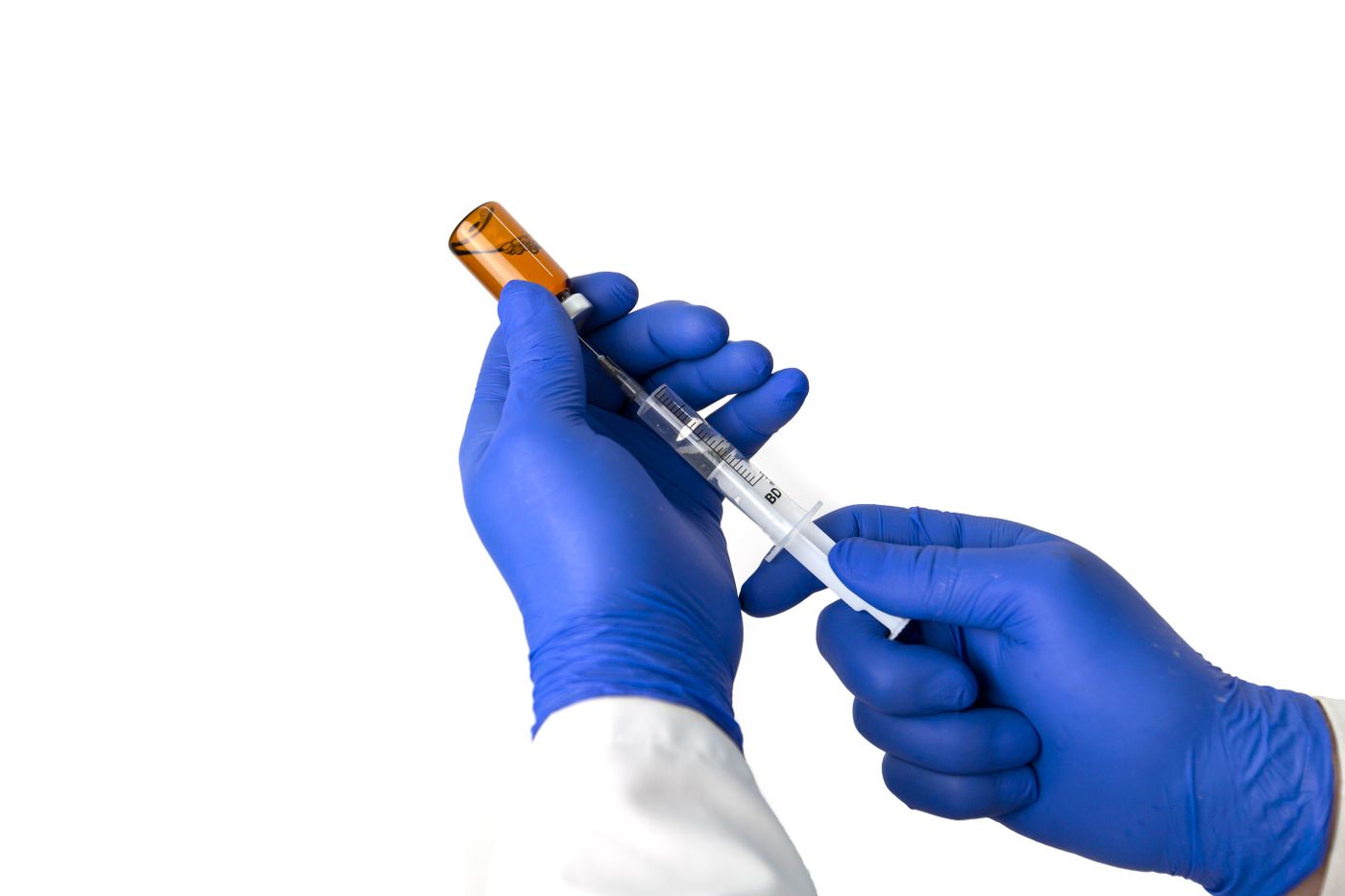
You know the feeling. The order reads 15 mg/kg, the vial is labeled in a different concentration than yesterday's, the patient's weight is charted in pounds, and somewhere behind you a pump is beeping. Your brain, which handled algebra just fine in school, suddenly produces static.
Medication math anxiety is one of the most common confessions we hear from nursing students, and it deserves a direct answer: this skill is beatable, and more beatable than most clinical skills. Dosage calculation is not a vast field of mathematics. It is a small set of formulas applied over and over, plus a handful of habits that catch mistakes before they reach the patient.
This guide walks through the four core calculations, shows fully worked examples you can check line by line, introduces dimensional analysis as an error-resistant alternative to formula memorization, and covers the safety habits, notation rules, and practice methods that turn shaky arithmetic into quiet fluency.
The anxiety is real, but it is mostly not about math. It is about stakes. A wrong answer on a classroom worksheet costs points; a wrong answer at the medication room counter could hurt someone. That pressure makes ordinary arithmetic feel like defusing a bomb.
Here is the reframe that helps our learners most: the clinical environment does not demand harder math than the classroom. It demands the same simple math done reliably. Division, multiplication, and unit conversion cover nearly everything a bedside nurse calculates. The professionals who look effortless are not faster mathematicians. They run a fixed routine every time, so the routine does the remembering for them.
That routine is worth making explicit, because every step exists to catch a different kind of error.
Nearly every bedside calculation is one of these four. Learn them as a set and you have mapped the whole territory.
1. Basic dose: D/H x Q. Desired dose (D) divided by the dose you have on hand (H), multiplied by the quantity (Q) the on-hand dose comes in. This handles tablets, oral liquids, and injectable volumes.
2. Weight-based dosing: mg/kg. Convert the patient's weight to kilograms (divide pounds by 2.2), multiply by the ordered mg/kg, then divide by the number of doses per day if the order is written per day. Pediatrics lives here, but so do heparin, many antibiotics, and most critical care drips.
3. Pump rate: mL/hr. Total volume in milliliters divided by total time in hours. Infusion pumps are programmed in mL/hr, so this is the workhorse of IV therapy.
4. Gravity drip rate: gtt/min. Volume in mL multiplied by the tubing's drop factor (gtt/mL, printed on the packaging), divided by time in minutes. When a pump is unavailable it is the only tool you have, and it is the formula nurses lose most marks on. It has its own full treatment, including the drop factor and the shortcut rules, in IV Flow Rate Calculation: gtt/min and mL/hr, Worked Step by Step.
Example 1: oral suspension. Order: amoxicillin 500 mg PO. On hand: 250 mg per 5 mL suspension. D/H x Q gives 500 divided by 250, which is 2, multiplied by 5 mL. Answer: 10 mL. Estimate check: the order is exactly double the reference dose, so the volume should be exactly double the reference volume. It is.
Example 2: weight-based pediatric dose. Order: 15 mg/kg/day divided every 12 hours. The child weighs 66 lb. First convert: 66 divided by 2.2 equals 30 kg. Daily dose: 15 x 30 equals 450 mg/day. Divided every 12 hours means two doses, so each dose is 225 mg. If the suspension on hand is 125 mg per 5 mL, the volume is 225 divided by 125, which is 1.8, multiplied by 5 mL: 9 mL per dose. Estimate check: 225 mg is a bit less than double 125 mg, so the volume should be a bit less than double 5 mL. Nine milliliters fits.
Example 3: infusion rates. Order: 1,000 mL of normal saline over 8 hours. Pump rate: 1,000 divided by 8 equals 125 mL/hr. Estimate check: a little over two millilitres a minute, which is a believable maintenance rate. If that same order has to run by gravity instead, the answer depends entirely on the drop factor of the tubing in your hand, and the same order gives four different answers on four different sets. That is worked through properly in IV Flow Rate Calculation.
Some learners never feel secure with memorized formulas, and there is a respectable alternative: dimensional analysis, also called the factor-label method. Instead of recalling which letter goes on top, you chain conversion factors so that unwanted units cancel and only the unit you want survives.
Rework Example 2 that way. Start with what you know about the patient and multiply by fractions that are each equal to one: 66 lb x (1 kg / 2.2 lb) x (15 mg / kg per day) x (1 day / 2 doses) x (5 mL / 125 mg). Pounds cancel, kilograms cancel, days cancel, milligrams cancel, and the arithmetic collapses to 9 mL per dose, the same answer as before.
The power of the method is that it fails loudly. If you set up a factor upside down, the units refuse to cancel and the nonsense is visible on paper before any arithmetic happens. With formula memorization, an inverted D and H produce a clean-looking wrong number. That is why many programs, and our own student support sessions, teach dimensional analysis as the primary method and formulas as the shortcut you graduate into.
Serious dosing errors are rarely off by 10 percent. They are off by a factor of 10, because a decimal slid or a unit flipped. Estimation is the cheap, powerful defense: before you calculate precisely, predict roughly, and before you draw anything up, compare the two.
Build the habit with three quick questions. Is the answer in the same neighborhood as the reference dose on the label? Is the volume physically plausible (a 38 mL intramuscular injection is not; a tenth of a tablet is not)? Is the dose plausible for this patient's size? A calculated answer that fails any of these questions is not a math problem anymore. It is a stop sign.
Two unit pairs cause a disproportionate share of trouble. Milligrams and micrograms differ by a factor of 1,000, and drugs like levothyroxine are routinely labeled in both (0.125 mg and 125 mcg are the same dose). Pounds and kilograms differ by a factor of 2.2, so a weight documented in the wrong unit more than doubles or halves every weight-based dose downstream. Always write the unit next to every number you touch, and convert before you calculate, not during.
Notation matters just as much, and here the guidance is formal. The Institute for Safe Medication Practices (ISMP) urges two rules that every student should treat as law. Always use a leading zero before a decimal point: write 0.5 mg, never .5 mg, because a missed decimal point turns it into 5 mg, a tenfold overdose. Never use a trailing zero: write 5 mg, never 5.0 mg, because the same missed decimal turns it into 50 mg. One character, one order of magnitude.
Some drugs punish errors more severely than others. Insulin, heparin and other anticoagulants, opioids, and concentrated electrolytes appear on ISMP's high-alert medication lists because errors with them are especially likely to cause serious harm. For these, arithmetic confidence is necessary but not sufficient. The professional standard is the independent double check.
Independent is the operative word. A colleague watching you calculate, nodding along, will follow your reasoning straight into your mistake. Done properly, the second nurse takes the order and the product, performs the entire calculation alone without seeing your work, and only then do you compare answers. If the answers differ, neither of you argues from authority; you both recalculate from the order.
Fluency, not familiarity, is the goal: the ability to produce a correct, checked answer while tired, interrupted, and watched. That comes from the same deliberate practice that builds any clinical skill. Work small mixed sets daily rather than marathon sessions weekly, because retrieval strengthens with spacing. Practice every problem with the full five-step routine, including the estimate check, so the routine becomes automatic rather than optional. And say your setup out loud while practicing; verbalizing exposes the setup errors that silent work hides.
Track your misses by category, using the chart above as a starting taxonomy. Two weeks of tallies will tell you whether your weakness is conversions, decimals, or setup, and then your practice can target the actual gap. Our free med math practice sheet is organized around exactly these categories, with answer keys that show the full worked setup for every problem.
Do nurses really use dosage calculation daily, or do pumps and pharmacy do it all? Technology has absorbed a lot of arithmetic, but the nurse remains the last check before administration. You still calculate whenever you draw up a partial vial, give a weight-based dose, titrate a drip, or sanity-check what a device claims. The math you keep is exactly the math that catches machine and transcription errors.
Is it acceptable to use a calculator at the bedside? Yes, and you should for anything beyond trivial arithmetic. The skill being tested in practice is not mental multiplication; it is correct setup, correct units, and a sensible final answer. A calculator executes your setup faithfully, including a wrong one, which is why the estimate check still applies.
Which method should I learn first, formulas or dimensional analysis? If you are starting fresh, learn dimensional analysis first. It is one consistent procedure for every problem type, and its unit-cancellation structure makes setup errors visible. Formulas then become fast shortcuts you can always verify against the long method.
How many practice problems per day actually help? Ten focused problems with full setup, estimation, and error tracking beat fifty rushed ones. Consistency matters more than volume: a daily short set for a month builds more durable fluency than a weekend cram, because spaced retrieval is what moves skills into long-term memory.
This article is the map. Each of these goes deep on one part of it.
Every Wahero course that touches medications builds calculation practice into the hands-on work, because math confidence and clinical confidence rise together. If rates specifically are where you lose marks, IV Flow Rate and Drip Rate Calculation is three hours on that alone, and Medication Safety and Dosage Calculation is the broader session that comes first. You can also explore our student resources, or tell us what your program needs through our interest form.
Educational content only
This material is published by Wahero Health Institute for professional education and is not individual medical advice, a care protocol, or a substitute for clinical judgment. Always follow your facility's policies, your state's nurse practice act, and your own scope of practice, and confirm medication doses against a current authoritative reference before administration. See our Terms of Use.