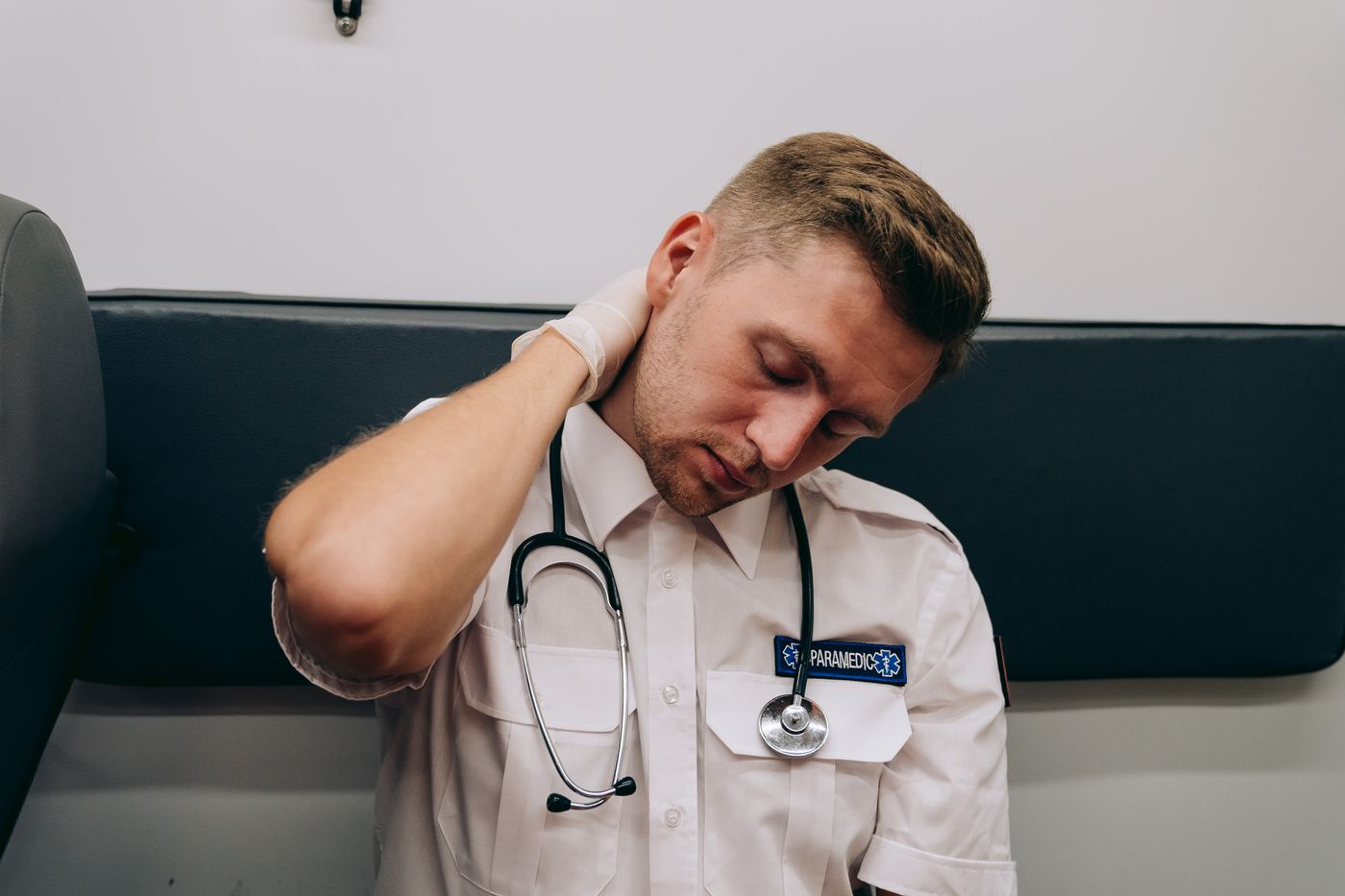
At 05:40 on the third of three consecutive twelve hour shifts, a nurse withdraws a needle from a patient's arm, turns toward the sharps container two steps away, and stops because she cannot remember whether she activated the safety sheath. She had. The pause cost her nothing this time. What is worth noticing is not the injury that did not happen, it is that her brain briefly stopped recording what her hands were doing.
That gap is what fatigue looks like from the inside, which is to say it mostly does not look like anything. Nurses are trained to report fatigue as a feeling, and feeling is the least reliable instrument for measuring it. The word "tired" does at least four separate jobs in a hospital, each with a different mechanism, risk profile and fix. Collapsing them into one thing is the biggest reason fatigue advice fails.
This article separates the four, then covers the physiology of sleep debt, the evidence linking fatigue to error and needlestick injury, why "I am used to it" is a measurement failure, how other industries engineer fatigue out, and what you control versus what only staffing can fix.
Watch on YouTube: Fatigue among healthcare workers, from our educator's own channel, Spice to health$Nursevibes.
Sleepiness is the pressure to fall asleep, generated by two things only: how long you have been awake, and where you are in your circadian cycle. It produces microsleeps, and the only thing that repays it is sleep. Caffeine masks it, and an emergency masks it magnificently for twenty minutes, but neither clears the debt.
Physical fatigue is muscular and metabolic: thousands of steps on hard flooring, repeated patient handling, static standing. It responds to rest, hydration and load reduction, and it degrades judgment far less than it feels like it should. You can be physically wrecked and cognitively sharp.
Cognitive fatigue is the depletion produced by hours of vigilance and dense decision making, and it accumulates even in a fully rested person. It is why hour ten of a busy shift feels different from hour two on identical sleep. Its fix is task design: rotation, genuine breaks away from the unit, and fewer decisions per hour.
Burnout is not fatigue at all in physiological terms. The World Health Organization classifies it in ICD-11 as an occupational phenomenon with three dimensions: exhaustion, cynicism or mental distance from the job, and reduced professional efficacy. The research tradition behind that definition, led by Christina Maslach, locates its causes in the conditions of work: workload, control, reward, community, fairness and values. Neither sleep nor a vacation treats it, because whatever generates it is still there when you return.
Alertness is usually modelled as two interacting processes, a framework introduced by Alexander Borbély and still the backbone of sleep science. Process S is homeostatic sleep pressure, which builds from the moment you wake and is associated with accumulating adenosine in the brain. Process C is the circadian drive from the suprachiasmatic nucleus, which moves alertness up and down on a roughly 24 hour cycle regardless of how long you have been awake.
Night shift stacks both processes against you. You are asked to perform at your most exacting between roughly 03:00 and 05:00, when circadian drive is near its lowest point and you have already been awake since the afternoon. Recovery sleep then happens in daylight, against your rhythm, and is typically shorter and more fragmented than night sleep of the same intended length. The debt grows across a run of nights even when you go to bed on time, and a weekend does not zero it. The CDC's National Institute for Occupational Safety and Health publishes a free training module for nurses on shift work and long work hours, written for your schedule rather than a nine to five one.
This is the idea the video above spends most of its time on. Adaptation would mean the impairment goes away. What the evidence shows is that the feeling of impairment goes away while the impairment keeps accumulating.
The reference finding comes from the chronic sleep restriction work of Hans Van Dongen and colleagues, published in the journal Sleep in 2003. Participants held to restricted sleep for two weeks kept degrading day after day on objective sustained attention testing, while their own ratings of sleepiness rose only modestly and then levelled off. They became progressively more impaired and progressively less aware of it.
There is a mechanical reason this feels convincing from the inside. Fatigue attacks the functions you cannot feel yourself using: sustained attention, error monitoring, inhibiting the automatic response, and updating a plan when the situation changes. It largely spares well practiced motor skills. So a nurse at hour eleven still draws up cleanly, still hangs the bag, still talks fluently, and concludes she is fine. The parts still working are not the parts at risk.
Fatigue in healthcare is not a soft topic lacking a literature. The Joint Commission issued Sentinel Event Alert 48 in 2011 on health care worker fatigue and patient safety, identifying extended work hours as a contributor to adverse events and asking organizations to treat fatigue as a risk in handoffs and staffing. That is an accreditation body naming a hazard.
The strongest experimental evidence comes from the Harvard Work Hours, Health and Safety Group. In a randomised comparison published in the New England Journal of Medicine in 2004, Landrigan and colleagues found that intensive care interns on a traditional schedule with extended overnight shifts made substantially more serious medical errors than the same interns on a schedule that eliminated those shifts. Because the schedule was assigned rather than chosen, that answers the usual objection that tired clinicians simply have harder jobs.
On sharps, Ayas and colleagues reported in JAMA in 2006 that extended duration shifts were associated with increased risk of percutaneous injuries among interns, concentrated during night work. That is the microsleep story applied to the moment a sharp is uncapped in your hand. For nurses, Rogers and colleagues, writing in Health Affairs in 2004 from detailed staff nurse logbooks, found error risk rising once shifts ran beyond about twelve and a half hours, and rising further with overtime. Barger and colleagues added the drive home, reporting in 2005 that extended shifts carried higher crash and near miss risk on the commute.
One honest caveat: much of the nursing evidence is observational and relies on self reported hours, so effect sizes deserve care. What persuades is the convergence of trials, injury surveillance, error logs and crash data. The American Nurses Association's position statement on nurse fatigue assigns responsibility to nurses and employers jointly.
Aviation, rail and nuclear power reached a conclusion healthcare has been slower to accept: fatigue is a predictable hazard of the schedule, so it must be controlled by the schedule. A Fatigue Risk Management System, as described in ICAO's guidance for aviation, is a data driven set of controls rather than an exhortation to sleep more. After the 2009 Colgan Air crash near Buffalo and the airline safety legislation that followed, the FAA replaced older duty rules with flight and duty limits and minimum rest requirements that account for time of day, not just total hours. The Nuclear Regulatory Commission enforces work hour controls for safety related duties, and the Federal Railroad Administration requires railroads to build fatigue management into their safety programs. In none of them is stamina accepted as a control.
Four features transfer to a hospital. Hours are governed by rule, not endurance. Defenses are layered, so no single control must work perfectly. Reporting is non punitive: a pilot who declares unfit to fly is following the system, not failing it. And the obligation runs both ways, since the employer provides the sleep opportunity and the worker must use it.
Healthcare has no federal work hour limit for nurses comparable to aviation's, and regulation is state level and uneven. Texas is among the states that restrict mandatory overtime for hospital nurses and require hospitals to operate a nurse staffing committee with direct care nurse membership. The exceptions matter in practice, so read the statute and your facility policy rather than the version circulating in the break room.
Here is the division most fatigue content refuses to make. New graduates should read it closely, since a first year already runs a high cognitive load, as our guide to surviving the first year explains. You control roughly four things.
Protect the sleep opportunity you are given. The block between shifts is either used or spent, and that decision is made the evening before, not by willpower at 03:00. Manage light too: bright light early in a night shift, dark glasses on the drive home so daylight does not tell your suprachiasmatic nucleus the day is starting, blackout at home.
Use caffeine as a tool with a known half life. It blocks adenosine receptors, so it removes your perception of sleep pressure rather than the pressure itself, and it persists for hours: a 03:00 coffee is still measurably present when you try to sleep at 09:00. Front load it, then stop.
Nap short, where policy allows, because a brief nap taken before deep sleep sets in leaves less grogginess than a long one. NIOSH covers napping and sleep inertia, and facility policies vary, so check yours. Then plan the commute. If the drive home is your highest risk activity, treat it as one: nap first, share a ride, or delay departure.
What you do not control is longer and more consequential: census and acuity, your ratio, how many people called out, whether break coverage exists, whether the roster leaves a real sleep opportunity, rotation direction, on call load and mandatory overtime culture. Fatigue produced by understaffing is a staffing defect, and personal countermeasures are what you do while that defect is fixed, not a substitute for fixing it.
So the most useful individual action is often administrative: report fatigue events through your safety reporting system exactly as you would any other near miss, so the data exists. Systems change when a pattern is visible in the incident log, not because individuals privately absorb more. The same principle runs through our writing on why medication errors happen and how systems prevent them: the reliable fixes are structural, and your job is to make the hazard visible.
Is a twelve hour shift inherently unsafe? The evidence points at the tail rather than the block. Rogers and colleagues found error risk climbing once shifts ran beyond roughly twelve and a half hours, so the danger sits in the routine overrun, the added overtime and the run of consecutive shifts.
Can I train myself to need less sleep? No. Sleep need genuinely varies between people, but it is not trainable. What is trainable is your tolerance for the feeling of sleepiness, which is precisely the problem: you stop noticing the impairment while it continues.
How do I tell whether I am burned out or just sleep deprived? Test it against a genuine rest period. Sleep deprivation lifts after several nights of adequate sleep. If the exhaustion returns within an hour of arriving on the unit, alongside cynicism and a sense that your work accomplishes nothing, that is the burnout pattern, which responds to workload, control and fairness rather than rest.
What should I say when I am too fatigued to work safely? Say it early, and as a safety statement rather than a personal one: describe hours worked and sleep obtained, state the risk, and request a specific mitigation such as reassignment of a high risk task, break coverage or a second check. Then file it through incident reporting so the pattern is on record.
Fatigue management is a skill set, not a mood: naming which of the four states you are in, and raising a fatigue concern in language that gets acted on. Wahero Health Institute teaches both alongside our clinical programs, and our live training sessions are scheduled with shift workers in mind. Enrolled learners can review recordings any time through the student portal, which matters when your only free hour is 07:00 after a night shift.
Educational content only
This material is published by Wahero Health Institute for professional education and is not individual medical advice, a care protocol, or a substitute for clinical judgment. Always follow your facility's policies, your state's nurse practice act, and your own scope of practice, and confirm medication doses against a current authoritative reference before administration. See our Terms of Use.