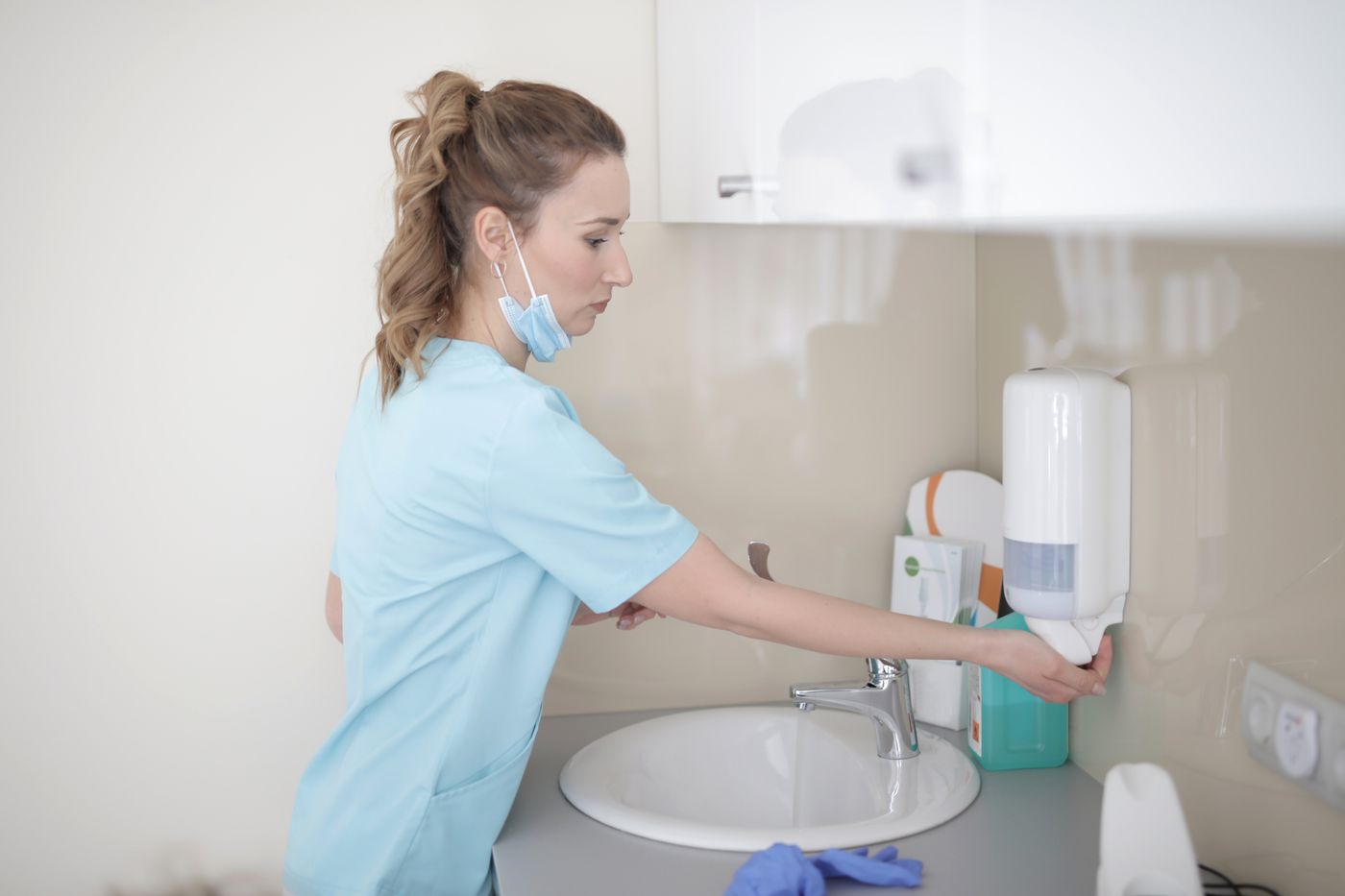
Photo: Andrea Piacquadio via Pexels
Ask a room of nurses whether they know how to clean their hands and every hand goes up. Ask what their unit's observed compliance rate was last quarter and the hands come down. That gap, between a skill learned in the first week of nursing school and a behavior that measured programs still struggle to deliver at half of opportunities, is this article's subject.
The Centers for Disease Control and Prevention's 2002 hand hygiene guideline put average observed adherence at 40%, and a 2010 systematic review of 96 studies by Erasmus and colleagues in Infection Control and Hospital Epidemiology found the same median.
This is not a technique tutorial; how you rub or wash is taught in person and assessed under observation. What follows is the part that transfers between employers: what the standards say, how compliance is measured, why it fails, and what an assessor is watching.
The most useful idea in modern hand hygiene is that the question is not whether you cleaned your hands today but whether you cleaned them at the moments when transmission could happen. The World Health Organization built that idea into its 2009 Guidelines on Hand Hygiene in Health Care as "My 5 Moments for Hand Hygiene", an approach developed by Sax, Allegranzi, Pittet and colleagues and published in the Journal of Hospital Infection in 2007.
The five moments are before touching a patient, before a clean or aseptic procedure, after a body fluid exposure risk, after touching a patient, and after touching the patient's surroundings. The first two protect the patient; the last three protect everyone else. The WHO's 2009 Hand Hygiene Technical Reference Manual trains observers to score opportunities against these moments.
The CDC's current clinical guidance lists its key moments in similar terms, and The Joint Commission's National Patient Safety Goal NPSG.07.01.01 lets an accredited organization build its program on either the CDC or the WHO guideline, provided it does not mix the two. From January 2026 the hospital manual carries its goals as National Performance Goals under new numbers; your facility's accreditation team holds the current number for the hand hygiene requirement. Your facility has chosen one, and the moments it audits follow from that choice.
Moment two is the one most often lost on a busy unit because it arrives mid-task, with the nurse already gloved at the bedside. Device care is where moments two and five stack up, which is why our printable Peripheral IV Maintenance study guide treats hand hygiene as a thread through every maintenance task rather than a box ticked at the door.
The second thing everyone thinks they know is which product to use. The CDC's 2002 Guideline for Hand Hygiene in Health-Care Settings made alcohol-based hand rub the default: if hands are not visibly soiled, an alcohol-based rub is the routine choice, a Category IA recommendation, and soap and water is for hands that are visibly dirty or contaminated with proteinaceous material.
The CDC's current guidance says it in plainer words: unless hands are visibly soiled, alcohol-based hand sanitizer is preferred over soap and water in most clinical situations. The reasons are efficacy and skin; the CDC notes that sanitizer leaves skin with less irritation and dryness than soap and water, and damaged skin is one of the documented reasons compliance falls.
The exceptions are where candidates stumble in a knowledge check. The CDC encourages soap and water after caring for patients with known or suspected infection during outbreaks of Clostridioides difficile and norovirus, because alcohol does not reliably inactivate C. difficile spores, while saying that access to sanitizer should not be restricted. The 2022 SHEA/IDSA/APIC practice recommendation on hand hygiene, published in 2023, takes the same line. Whether your facility applies the soap-and-water rule to every C. difficile patient or only during an outbreak is a local decision, and the answer an assessor wants is the one in your policy.
The sentence that reorganized the skill. Unless hands are visibly soiled, alcohol-based hand sanitizer is preferred over soap and water in most clinical situations. That is the CDC's current wording, and it is why dispensers moved from the sink to the doorway and the bedside.
Printable study guide
Get the printable Peripheral IV Maintenance study guide
A printable study guide from Wahero Health Institute to the basic skills of peripheral IV maintenance, the device care where hand hygiene moments two and five are tested most often. For skills lab and check-off revision; it does not replace your facility's procedure.
Peripheral IV Maintenance, $12.99
Pay by Cash App, PayPal or Zelle at checkout; the download link is emailed once the payment is confirmed, usually the same day. Study material only: it does not replace the Board's requirements, your employer's policies or the judgment of a licensed clinician.
Hand hygiene is the one clinical skill routinely measured at unit level, and the measurement is harder than it looks. The Joint Commission's 2009 monograph, Measuring Hand Hygiene Adherence: Overcoming the Challenges, reviewed the three methods in common use: direct observation during care, product consumption, and surveys.
Direct observation is the WHO's reference method and the only one that captures technique and the specific moment missed. Its weakness is the Hawthorne effect: people who know they are watched behave better, so the same recommendation says overt observation should not set routine adherence rates, and that short, unannounced observations by observers unknown to the unit reduce the bias.
Product consumption, usually the volume dispensed per patient-day, avoids the observer problem but cannot say who used the product, for which moment, or how well. Electronic monitoring captures far more opportunities, but accuracy varies and validation methods are unsettled. The authors' honest conclusion is that no single method is likely to meet all of a program's needs.
The CDC's 2002 guideline collected the barriers healthcare workers themselves report, and the list has barely changed in twenty years: skin irritation from hand hygiene agents, inaccessible supplies, wearing gloves, forgetfulness, insufficient time, high workload and understaffing, patient needs taking priority, and not knowing the guidelines. The WHO's 2009 guideline adds that adherence falls as the intensity of care rises, so the busiest moments are the ones most often missed.
The Erasmus review found compliance lower in intensive care, lower among physicians than nurses, and lower before patient contact than after. That last finding is the one to internalize: cleaning hands after a task is partly self-protective and comes naturally, while cleaning them before a task protects the patient and has to be deliberate.
Skin is the barrier that compounds, and the SHEA/IDSA/APIC recommendation treats it as a system problem: facilities educate staff on preventing dermatitis and provide approved moisturizers compatible with the antiseptics and gloves in use.
Glove use is the barrier that looks like compliance from a distance. The CDC's guidance is unambiguous: gloves are not a substitute for hand hygiene, they do not provide complete protection against hand contamination, and hands are decontaminated after glove removal. The SHEA/IDSA/APIC update goes further: whenever hand hygiene is indicated during an episode of care, personnel remove the gloves and clean their hands rather than continue in the same pair.
The unit pattern is familiar: gloves donned in the corridor, worn from the computer to the bedside to the supply room, treated as if they clean themselves. An observer trained on the WHO tool records each transition as a missed opportunity, and as our article on urinary catheter competency notes, device care generates several moments in quick succession that gloved hands make feel too small to stop for.
What glove misuse tells an assessor. A nurse who cleans hands before gloving and after removing gloves understands what the glove is for. One who wears a pair across three tasks has mistaken a barrier for a clean hand: a knowledge gap, not a time problem.
Two different things get assessed, and candidates confuse them. Competency is individual: can this nurse perform hand hygiene correctly, with the right product, at the right moments? Compliance is organizational: across hundreds of observed opportunities, how often did staff act? The first is checked in skills lab and at onboarding; the second is measured on the unit and reported to leadership and accreditors.
The competency check is observed against the facility's own procedure, and always with questions: which moment applies here, which product, and why. Programs validating a broader skill, such as the IV site assessment competencies we have written about, embed hand hygiene as a continuous thread, so a candidate can pass every technical step and still fail on the moments between them.
Compliance assessment carries regulatory weight. Under NPSG.07.01.01 an accredited organization must implement a hand hygiene program, set goals, monitor the results and act on them. Since 1 January 2018 a Joint Commission surveyor who observes an individual failing to perform hand hygiene during direct patient care can cite it as a deficiency under the Infection Prevention and Control chapter. In Texas, the Board of Nursing's Rule 217.11 requires every nurse to know and conform to the Nursing Practice Act and the Board's rules and to implement measures that promote a safe environment; your facility's hand hygiene policy is one of those measures.
Feedback is the part that changes behavior. The SHEA/IDSA/APIC recommendation finds it most effective from a supervisor or colleague, more than once, with clear targets. A unit that publishes a number and does nothing else has measured compliance without assessing it, the point we make in building a competency validation program: a measurement is only useful if it feeds a decision.
Educational use. This article is learning material for nurses and nursing students. It is not clinical advice, and it does not replace your employer's policies, your facility's protocols, or the judgement of a licensed clinician. Always follow the standards and procedures in force where you practise.
Is alcohol-based sanitizer always better than soap and water? Not always, but it is the default. The CDC's guidance is that unless hands are visibly soiled, alcohol-based sanitizer is preferred in most clinical situations. Soap and water is the choice when hands are visibly soiled, before eating, after using the bathroom and, per the CDC and the SHEA/IDSA/APIC recommendation, during Clostridioides difficile and norovirus outbreaks. Your facility's policy says how it applies those exceptions.
Why measure compliance by direct observation if being watched changes behavior? Because observation is the only method that shows which moment was missed and whether technique was adequate, which is what feedback needs. The SHEA/IDSA/APIC recommendation manages the Hawthorne effect with short, unannounced observations by people the unit does not recognize, and most programs pair observation with product volume or electronic monitoring.
Do gloves count as hand hygiene? No. The CDC states that gloves are not a substitute for hand hygiene and recommends decontaminating hands after removing gloves. The 2022 SHEA/IDSA/APIC update adds that when a hand hygiene moment arises during care, the nurse removes the gloves and cleans their hands rather than continuing in the same pair.
Does this article teach hand hygiene technique? No, deliberately. Technique is taught in person with the products your facility stocks and validated by observation. This piece covers the standards, the measurement and the assessment, which are the parts that travel with you between employers.
Wahero Health Institute delivers observed, on-site skills validation for Texas facilities, with hand hygiene running through every competency we assess. If your unit's numbers and its practice have drifted apart, talk to us.
Educational content only
This material is published by Wahero Health Institute for professional education and is not individual medical advice, a care protocol, or a substitute for clinical judgment. Always follow your facility's policies, your state's nurse practice act, and your own scope of practice, and confirm medication doses against a current authoritative reference before administration. See our Terms of Use.
