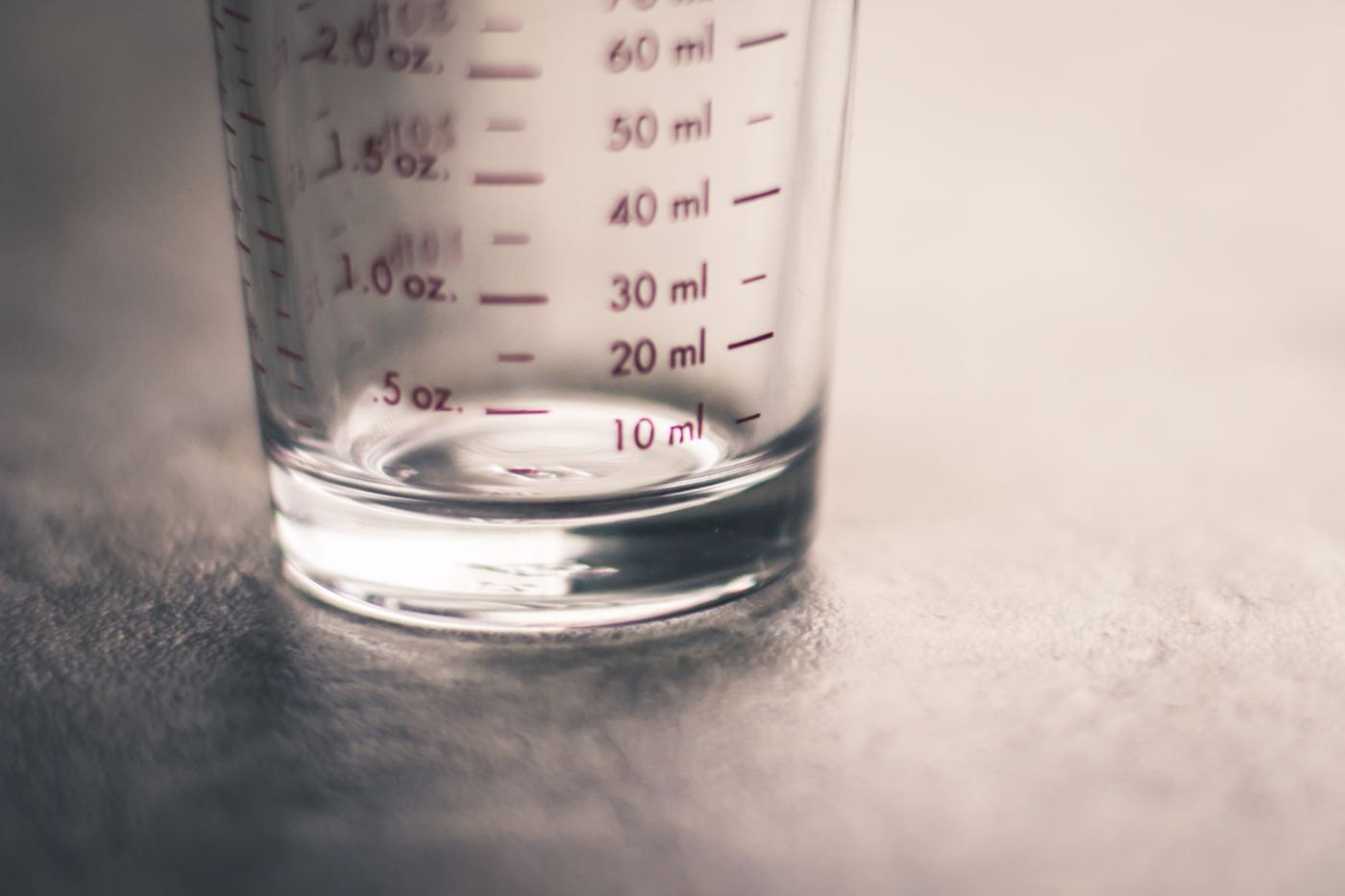
A line that circulates in study groups, on flashcards and in shared revision notes says that one teaspoon equals five ounces. It is wrong, and it is wrong by a factor of about thirty. What makes it worth opening an article with is the shape of the error rather than its size. The number in it is perfectly correct. Only the unit is wrong.
A teaspoon is five millilitres. Work the ounce version and the absurdity becomes visible in one line: one fluid ounce is approximately 29.57 mL, so one ounce holds about 5.91 teaspoons, usually rounded to six. Turn that around and a single teaspoon is roughly 0.17 of an ounce. Five ounces is about 148 mL, close to two thirds of a standard cup. Nobody has ever swallowed that from a teaspoon.
That is the whole argument of this article in miniature. A conversion you can derive survives a tired night shift, an unfamiliar chart and a question phrased in units nobody expected. A conversion you have only memorised does not, because memory under fatigue drops units before it drops digits. What follows is the full conversion set nurses are taught, in mass, volume, weight and temperature, presented with the derivation attached to each one. For the calculation method that sits on top of these, including dimensional analysis, start with our guide to medication math without panic.
Conversion errors are not random. They cluster in a way that is worth understanding before looking at a single table, because the pattern tells you where to concentrate attention.
The first cluster is direction. Almost every unit relationship in clinical practice is a factor of a thousand or a factor of ten, so getting the direction backwards does not produce a slightly wrong answer. It produces an answer wrong by exactly that factor, which is the largest and least forgiving category of arithmetic error in the subject.
The second cluster is the swapped unit, of which the teaspoon claim is a perfect specimen. Ounces and millilitres both measure volume, so nothing about the sentence looks structurally broken. Only the size gives it away, and only if the reader knows the size.
The third cluster is the unit that quietly changes what a formula means. Weight-based calculation is done in kilograms; a figure that arrived on the chart in pounds and was used as though it were kilograms produces a result more than twice the intended one, without a single digit being mistyped.
The direction rule, in one sentence. Converting to a larger unit, divide. Converting to a smaller unit, multiply. A larger unit always yields a smaller number, so if the number grew when the unit did, the operation ran backwards.
The mass ladder used in clinical work has three rungs, and the gap between each pair is identical.
One gram is 1,000 milligrams. One milligram is 1,000 micrograms. Two steps of a thousand stacked on each other means one gram is 1,000,000 micrograms. There is nothing else to learn in this section; every mass conversion in practice is one or two applications of that single factor.
Worked across the whole ladder with one quantity: 2,500 mg. Converting upward to grams is a move to a larger unit, so divide by 1,000, giving 2.5 g. Converting downward to micrograms is a move to a smaller unit, so multiply by 1,000, giving 2,500,000 mcg. All three expressions describe exactly the same amount of substance.
Check the direction against the rule. Going up the ladder, the unit got bigger and the number got smaller, from 2,500 to 2.5. Going down, the unit got smaller and the number got much larger. When those two move in the same direction, the conversion is inverted and the answer is out by a factor of a thousand.
Volume carries more units than mass, and it is the only group in which household measures and clinical measures sit next to each other. That mixing is precisely why it generates the errors it does.
The clinical relationships are exact and short. One cubic centimetre equals one millilitre, exactly and by definition, because a cubic centimetre of space holds a millilitre of fluid. One litre is 1,000 millilitres, which is the same factor of a thousand seen on the mass ladder.
The household relationships are conventions, and it matters that they are described as such. One teaspoon is taken as 5 mL, one tablespoon as 15 mL (three teaspoons), and one cup as approximately 240 mL. One fluid ounce is approximately 29.57 mL, routinely rounded to 30 mL when a quantity is being explained to a patient or family.
The teaspoon figure deserves an honest footnote, because this article's entire premise is that measurement error is worth correcting. The United States legal teaspoon is defined as exactly 4.93 mL. Teaching material, dosing devices and conversion charts round it to 5 mL, and that rounding is a deliberate convention rather than an exact identity. It is close enough that the difference does not change how the arithmetic is taught, and it is worth knowing that the round number is a convention and not a definition.
Now put the circulating claim next to the truth. A teaspoon is 5 mL. Five ounces is about 148 mL. Those two quantities are not neighbours, they are not in the same room, and no measuring device confuses them.
The practical lesson is not that anyone should memorise this correction. It is that the arithmetic which exposes it takes one division. Anyone who knows that an ounce is roughly 30 mL and a teaspoon is 5 mL can derive that six teaspoons make an ounce, and from there the claim collapses without reference to any chart. Our free printable clinical conversions reference collects the whole set in one page for exactly that purpose, as a check rather than a substitute for the derivation.
One kilogram is 2.20462 pounds. In teaching and in most working arithmetic that is shortened to multiplying kilograms by 2.2, which is accurate enough for the size of number involved and easy to run without a calculator. Going the other way, pounds are divided by 2.2 to reach kilograms.
On the surface this is the least interesting conversion in the set. It has no factor of a thousand in it and the numbers are small. It is also the one with the sharpest consequence, for a reason that has nothing to do with the arithmetic itself.
Weight-based calculation is performed in kilograms. That is the unit the method assumes, the unit textbooks write their formulas in, and the unit a paediatric or weight-adjusted calculation is built around. A weight recorded in pounds and then carried into that calculation as though it were kilograms does not produce a small inaccuracy. It produces a result more than twice the intended size, and every step after it is internally consistent, so nothing downstream looks wrong.
Why the weight unit is checked first. A mass conversion run backwards leaves a number that looks obviously strange. A weight in the wrong unit leaves a number that looks entirely ordinary and quietly doubles everything derived from it. Confirming which unit a recorded weight is in costs one glance and removes an error the arithmetic cannot catch.
Worked briefly: a weight of 70 kg is 70 × 2.2 = 154 lb. Reverse it and 154 lb is 154 ÷ 2.2 = 70 kg. The failure mode is the middle case, where 154 sits on a chart with no unit attached and is read as kilograms. That is a 154 kg starting figure standing in for a 70 kg one, and the ratio between them is 2.2, permanently.
Temperature is the only conversion in the set that is not a simple multiplication, because the two scales do not share a zero. Fahrenheit puts zero somewhere below freezing and Celsius puts it at freezing, so an offset has to be removed before any scaling happens.
The formula taught is: C = (F − 32) × 5/9.
Worked at 68F. Subtract the offset first: 68 − 32 = 36. Then scale: 36 × 5/9 = 20. So 68F is 20C. The order matters, and reversing it is the standard way this calculation goes wrong. Scaling before subtracting produces an answer that is wrong in a way not obviously flagged by its size.
Where the formula is genuinely useful is when the four anchor points have been internalised, because then any answer can be sanity-checked before it is written down. Water freezes at 32F and 0C. Ordinary room temperature is about 68F and 20C. Normal body temperature is conventionally 98.6F and 37C. Water boils at 212F and 100C.
Those four pairs bracket everything a clinician meets. A converted value that lands between the room anchor and the body anchor is plausible; one that lands above boiling or below freezing has an arithmetic error in it, and the error is usually the order of operations.
Producing the right number and recording it safely are separate skills, and both are assessed. The Institute for Safe Medication Practices publishes conventions for writing numbers that exist because of one specific, well-documented failure: a decimal point that is missed, smudged, faxed into invisibility or lost in handwriting.
The first convention is the leading zero. A decimal quantity below one is written 0.5 mg, never .5 mg. If the bare decimal point is lost, the reader sees 5, and the quantity has become ten times what was written.
The second convention is the absent trailing zero. A whole quantity is written 5 mg, never 5.0 mg. If that decimal point is lost, the reader sees 50, and again the quantity is ten times what was written.
Both failures are tenfold, in opposite directions, and both are eliminated by a habit that costs nothing. The conventions apply to every number a nurse writes, not only to the output of a conversion. Our medication safety course covers them alongside the wider dose calculation method, and our article on IV flow rate calculation applies the same conventions to rate arithmetic specifically.
ISMP also maintains a list of abbreviations identified as error-prone, which is worth understanding for a reason that is often missed: these appear on older charts, in legacy documentation and in material still in circulation. The skill being taught is reading them correctly while not reproducing them.
The letter U for unit is the first. Handwritten, it closes up and reads as a zero or as a four, so a quantity written as 4U can be read as 40. The word "unit" written out in full removes the ambiguity entirely and costs three characters.
IU for international unit is the second, and it fails in two directions. It is misread as IV, which changes the meaning from a quantity into a route, and it is misread as the number 10. "International unit" is written in full.
cc is the third, and it is the most interesting because it is not arithmetically wrong. A cubic centimetre is a millilitre, exactly. The problem is entirely one of handwriting: a hurried cc closes into what reads as the letter u, which drags the quantity back into the units confusion above. The value is correct and the symbol is unsafe, so mL is written instead.
Recognise, do not reproduce. These abbreviations are still encountered on archived charts and in older teaching material, so a nurse has to be able to read them. The competency being assessed is knowing what they meant and writing the unambiguous form instead.
The conversions above are fixed. A gram is a thousand milligrams everywhere, a cubic centimetre is a millilitre everywhere, and the Celsius formula does not change between employers. That is what makes them worth deriving once rather than looking up repeatedly.
What does vary is everything built on top: which units a facility's documentation system requires, what rounding its policies permit, which abbreviations its records still contain, and how a recorded weight is captured and verified. Those are matters of local protocol and are governed by the organisation a nurse practises in, not by a conversion table.
The boundary is worth stating plainly. Learning material can teach the relationships between units and the arithmetic that connects them. It cannot decide how a particular number is applied to a particular patient, and it does not replace the policy in force where a nurse works.
Educational use. This article is learning material for nurses and nursing students. It is not clinical advice, and it does not replace your employer's policies, your facility's protocols, or the judgement of a licensed clinician. Always follow the standards and procedures in force where you practise.
Five millilitres. The claim that a teaspoon is five ounces takes a correct number and attaches the wrong unit to it. Five fluid ounces is about 148 mL, roughly thirty times a teaspoon and close to two thirds of a cup. The quickest way to keep the two apart is to remember that an ounce is about 30 mL, which means six teaspoons fit inside one ounce.
Yes, exactly. One cubic centimetre is one millilitre by definition, and the two are interchangeable as quantities. The Institute for Safe Medication Practices nonetheless lists cc as an error-prone abbreviation, because handwritten it can be misread as the letter u and pulled into the confusion around unit abbreviations. The value is right and the symbol is unsafe, so mL is written instead.
One thousand. The same factor separates milligrams from grams, so a gram contains a million micrograms. Because every rung of that ladder is the same factor, the only thing that can go seriously wrong is the direction: multiplying when the conversion should have divided produces an answer out by a thousandfold rather than by a small margin.
Because weight-based calculation methods are written in kilograms, and the formulas assume that unit. One kilogram is 2.20462 pounds, generally shortened to 2.2 in working arithmetic. A weight captured in pounds and carried into a kilogram-based calculation gives a result more than twice the intended size, and because everything downstream stays internally consistent, nothing about the final figure looks wrong.
Subtract 32, then multiply by 5/9, in that order. At 68F: 68 minus 32 is 36, and 36 times 5/9 is 20, so 68F is 20C. Keeping the four anchors in mind, 32/0, 68/20, 98.6/37 and 212/100, gives an instant check on whether an answer is even plausible before it is written down.
Conversions are the layer everything else in calculation rests on, and they are learned by working them rather than by reading them. Our IV Flow Rate and Drip Rate Calculation course is a three-hour assessed session, capped at 16 learners, priced at $79 per person, and it puts these conversions to work inside rate arithmetic under a clock. For dose calculation more broadly, including the number-writing conventions above, the medication safety course is the wider companion.