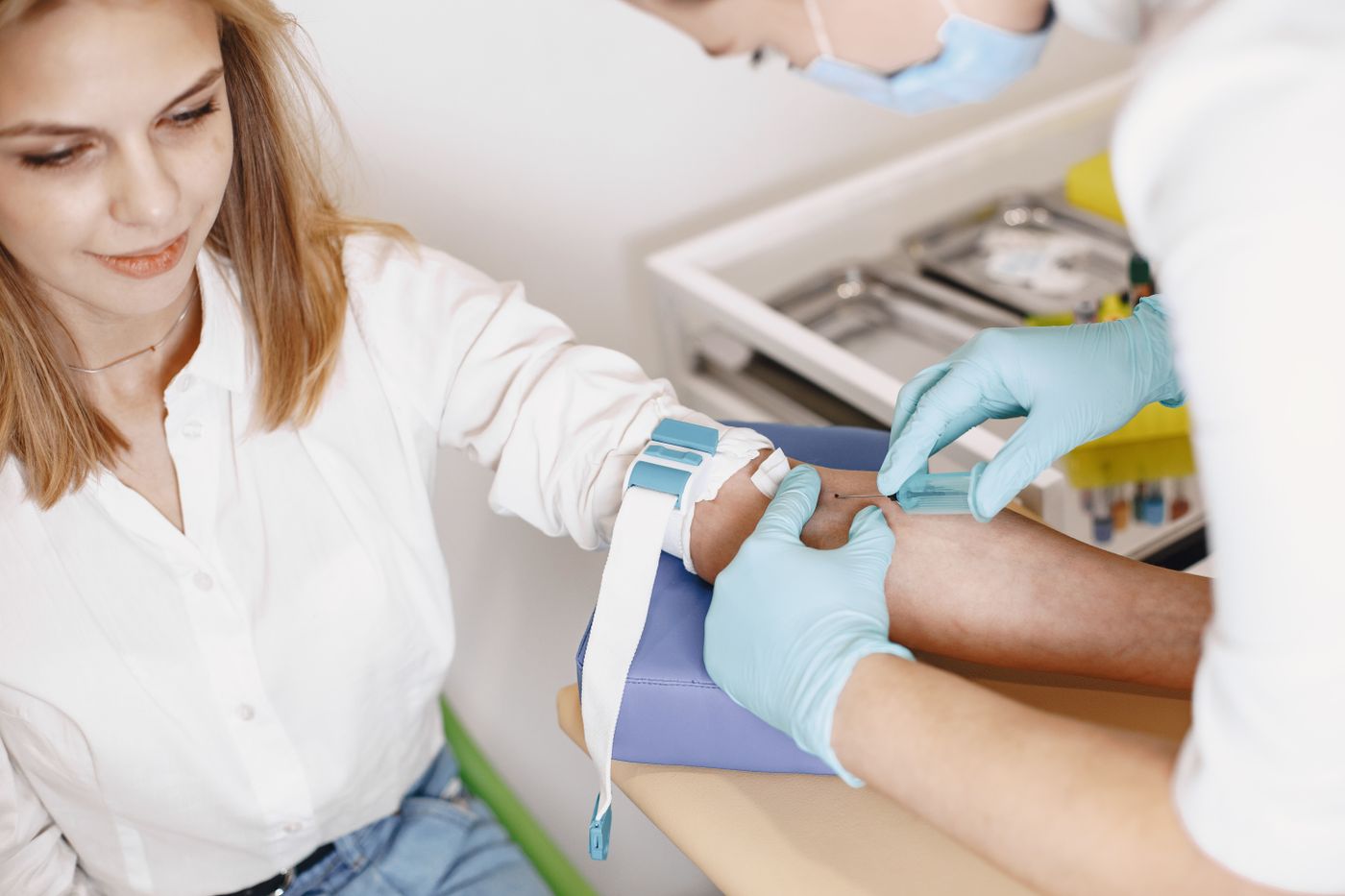
Photo: Gustavo Fring via Pexels
The venipuncture check-off is the first clinical skill many nursing students are formally scored on, and the one they most underestimate. The needle produces the nerves, so candidates rehearse the needle, then discover at the station that most of the marks on the sheet have nothing to do with it.
That is not a quirk of one program. The skill is defined by a patient safety goal from The Joint Commission, a collection standard from the Clinical and Laboratory Standards Institute, and a federal safety rule enforced by OSHA. Each describes a part of a blood draw where harm actually happens, and in none of them is that part the puncture.
This article explains what a venipuncture competency assesses, where each domain comes from, how supervised practice is counted, and what an assessor watches for. It is not a procedure guide: the technique is taught on a task trainer and then at a supervised bedside against your facility's procedure.
A blood draw competency scores five things: confirming who the patient is, preparing the collection against the laboratory's requirements, drawing safely for both people in the room, labeling the specimen so the laboratory can trust it, and disposing of the sharp and documenting the event. The puncture is the only one that improves mainly through repetition. The other four improve through knowing the standard.
A well-built checklist treats some items as critical: miss one and the attempt fails. The critical items cluster at the two ends, identification and labeling, because those are the points at which a specimen becomes attached to the wrong person. A smooth draw that produces a mislabeled tube is a patient safety event, not a pass.
The pattern worth remembering. Technique is scored on a scale. Identification, sharps safety and labeling are scored pass or fail. Candidates who prepare only for the scale lose the check-off at the gates.
The Joint Commission's National Patient Safety Goal NPSG.01.01.01 requires at least two patient identifiers when collecting blood samples and other specimens for clinical testing. It accepts the patient's name, an assigned identification number, telephone number or another person-specific identifier, and states that a room number or physical location is not one. The purpose is to identify the individual reliably and to match the service to that individual. For 2026 The Joint Commission reorganized its hospital goals as National Performance Goals and renumbered them; the two-identifier requirement carried over, and your facility's accreditation team holds the current number.
In a skills lab this is assessed as a behavior. The assessor watches whether you ask the patient to state the identifiers rather than reading them out for confirmation, whether you compare them against the order, and whether you do it before anything is opened. Identifying the patient after setting up is the sequence backwards, and many assessors score it as a critical miss.
The laboratory side has its own standard: CLSI PRE01, Patient and Laboratory Specimen Identification Processes, published in March 2024 to replace GP33, which covers everyone who collects and labels specimens. Your laboratory's collection manual reflects it, and that manual is what your check-off is written against.
The reference document for venous collection in the United States is CLSI GP41, Collection of Diagnostic Venous Blood Specimens, in its seventh edition (2017). CLSI describes it as covering venipuncture in adults and children, line collections, blood cultures and challenging patients, and the FDA recognizes it as a consensus standard. When a hospital phlebotomy policy cites a source, this is usually it.
Two features matter for a candidate. First, GP41 defines an order in which tubes with different additives are collected, because carryover from one tube can alter the result in the next. That order exists, it is set by the standard and by your laboratory, and it is printed on the chart your facility issues. This article does not reproduce it, deliberately: the version you are assessed on is the one in your lab's manual. Second, the standard addresses how tubes are filled and mixed so the ratio of additive to blood is correct. Those figures belong to the tube manufacturer and your laboratory.
Good assessors therefore ask rather than listen for recitals: which tube first for this set of orders, and where would you check? A candidate who says they would consult the lab's chart, and does, has shown the competency. The same logic runs through what IV insertion competency really takes: the preparation is the procedure, not the preamble.
Printable study guide
Get the printable Blood Draw Techniques study sheet
Blood Draw Techniques from Wahero Health Institute is a printable blood draw guide and techniques study sheet: a compact review to read beside your program's checklist and your facility's collection manual before a check-off.
Pay by Cash App, PayPal or Zelle at checkout; the download link is emailed once the payment is confirmed, usually the same day. Study material only: it does not replace the Board's requirements, your employer's policies or the judgment of a licensed clinician.
The OSHA Bloodborne Pathogens Standard, 29 CFR 1910.1030, governs every blood draw in a US workplace. It requires a written exposure control plan, engineering and work practice controls that eliminate or minimize exposure, hepatitis B vaccination offered to exposed staff, and a log of injuries from contaminated sharps. After the Needlestick Safety and Prevention Act was signed on November 6, 2000, OSHA revised the standard (published January 18, 2001, effective April 18, 2001) to require an annual review of safer devices with documented input from frontline employees.
In a check-off this is concrete. Activating the safety feature immediately after the draw, placing the device in a sharps container without recapping, and having that container within reach before you begin are scored, usually as critical items. The standard prohibits recapping unless the employer can show there is no feasible alternative, so a recap is a rule broken, not a style choice.
The CDC estimates about 385,000 needlestick and other sharps injuries a year among hospital-based healthcare personnel, half or more of them unreported, with nursing staff accounting for most reported cases. OSHA requires sharps containers to be easily accessible and as close as feasible to where sharps are used. A candidate who draws first and looks for the container afterwards has created the moment in which many injuries happen: a used needle in a hand with nowhere to go.
The second element of NPSG.01.01.01 states that containers used for blood and other specimens are labeled in the presence of the patient. That phrase is the whole competency. A tube labeled at the nurses' station traveled unlabeled and could have been swapped with another, and the error is invisible to the laboratory because a label, once applied, looks correct.
What goes on the label is set by your laboratory: the same two identifiers at minimum, usually date, time and collector, and increasingly a barcode. The CDC-funded Laboratory Medicine Best Practices review by Snyder and colleagues (Clinical Biochemistry, 2012) pooled 17 studies and found barcoding associated with far fewer identification errors (pooled odds ratio 4.39, evidence rated high). Barcodes only help when the label meets the right tube beside the right patient.
A College of American Pathologists Q-Probes study across 147 laboratories (Wagar and colleagues, 2008) found labeling errors at 0.92 per 1,000 labels. Reassuring, until you convert the rate into tubes: a hospital drawing thousands of specimens a day is recollecting several every day, and each one is another needle for a patient. That is why a documented competency validation program scores labeling rather than posting a reminder.
What a good candidate says out loud. "I am labeling this here, with you, before I leave the room." Narrating the gate tells the assessor the behavior is deliberate.
Students ask for a number. There is no national number for nursing programs; each school and employer sets its own in its competency policy, and it varies widely.
Where a named body publishes a figure, it comes from phlebotomy certification. The American Society for Clinical Pathology's Board of Certification lists, for its Phlebotomy Technician credential, a structured-program route of at least 40 clock hours of classroom instruction plus clinical training documenting 100 successful unaided venipunctures. The World Health Organization's 2010 guideline on drawing blood states the principle instead: health workers should be trained in, and demonstrate proficiency for, the collection procedures on the patient population within their scope of practice.
Nursing programs follow the WHO logic: you are signed off when an assessor has seen you meet the standard on a task trainer and then on supervised live draws, not when a counter reaches a number. Any minimum your program sets will be in its competency policy, and our printable Blood Draw Techniques study sheet is built to sit beside that policy and your lab's chart while you prepare.
Assessors converge on the same list. They watch whether you confirm identity before touching equipment. They watch hand hygiene and gloves as a continuous thread, in line with the CDC's hand hygiene guidance for healthcare settings. They watch whether you explain what is about to happen, which the WHO guideline treats as part of a safe draw. They watch the seconds after the draw: safety feature activated, container used, site care per your facility's procedure. They watch labeling, in the room. And they watch what you do when something goes wrong.
That last item is where the judgment lives. The point at which you stop after an unsuccessful attempt and hand over is set by facility policy, and the competency is knowing and following it. Recognizing that a tube is underfilled or a label is wrong, and saying so, is a pass. Sending it and hoping is a documented fail, because the laboratory will find it.
Facilities revalidate this competency periodically because behaviors drift: labels migrate to the desk, containers end up across the room. Our piece on planning a skills fair that people turn up to describes how to run that validation as an observed station rather than a signature sheet.
Educational use. This article is learning material for nurses and nursing students. It is not clinical advice, and it does not replace your employer's policies, your facility's protocols, or the judgement of a licensed clinician. Always follow the standards and procedures in force where you practise.
Does this article tell me the order of draw? No, on purpose. An order exists, it is defined by the CLSI GP41 standard, and your laboratory issues the version for its own tube system. The competency assessed in skills lab is knowing that the chart exists and using it, not reciting a sequence that may not match your facility.
How many supervised blood draws do I need before I am signed off? There is no national number for nursing programs; each school and employer sets its own. The figures seen online usually come from phlebotomy certification: the ASCP Board of Certification lists a structured-program route that documents 100 successful unaided venipunctures. The WHO guideline states the principle instead: demonstrated proficiency on the patient population within your scope of practice.
Is recapping a needle ever acceptable? The OSHA Bloodborne Pathogens Standard prohibits bending, recapping or removing contaminated needles unless the employer can show there is no feasible alternative or a specific procedure requires it, and then only by a one-handed technique or a mechanical device. In a skills lab a recap is scored as a rule broken. Your facility's exposure control plan states the position that applies to you.
If your program scores venipuncture on technique alone, it is certifying one fifth of the competency. Wahero Health Institute runs vascular access and specimen collection training on site, assessed under observation against your own laboratory manual and exposure control plan.
Educational content only
This material is published by Wahero Health Institute for professional education and is not individual medical advice, a care protocol, or a substitute for clinical judgment. Always follow your facility's policies, your state's nurse practice act, and your own scope of practice, and confirm medication doses against a current authoritative reference before administration. See our Terms of Use.
