A director of nursing has forty staff who need competency signed off on a new smart infusion pump before the go-live date. She has two ways to get there. She can send nurses out, a few at a time, to a training center across the city, or she can bring an educator into her own building to run the same competency on the units where the pumps will actually be used.
On paper the send-out option looks cheaper, because the quoted price is a tuition figure per seat, small and clean. The numbers she cannot see, the shift she has to backfill, the mileage and windshield time, the nurse who comes back having trained on a different pump model than the one on her floor, are the ones that decide whether it was a good decision.
This article is about that hidden arithmetic. It sets out what on-site, mobile clinical training actually is, when bringing the trainer to the building genuinely beats sending people out, where the real costs sit, how a session runs on a unit that cannot close, and how to tell a serious training provider from a slide deck with a travel budget.
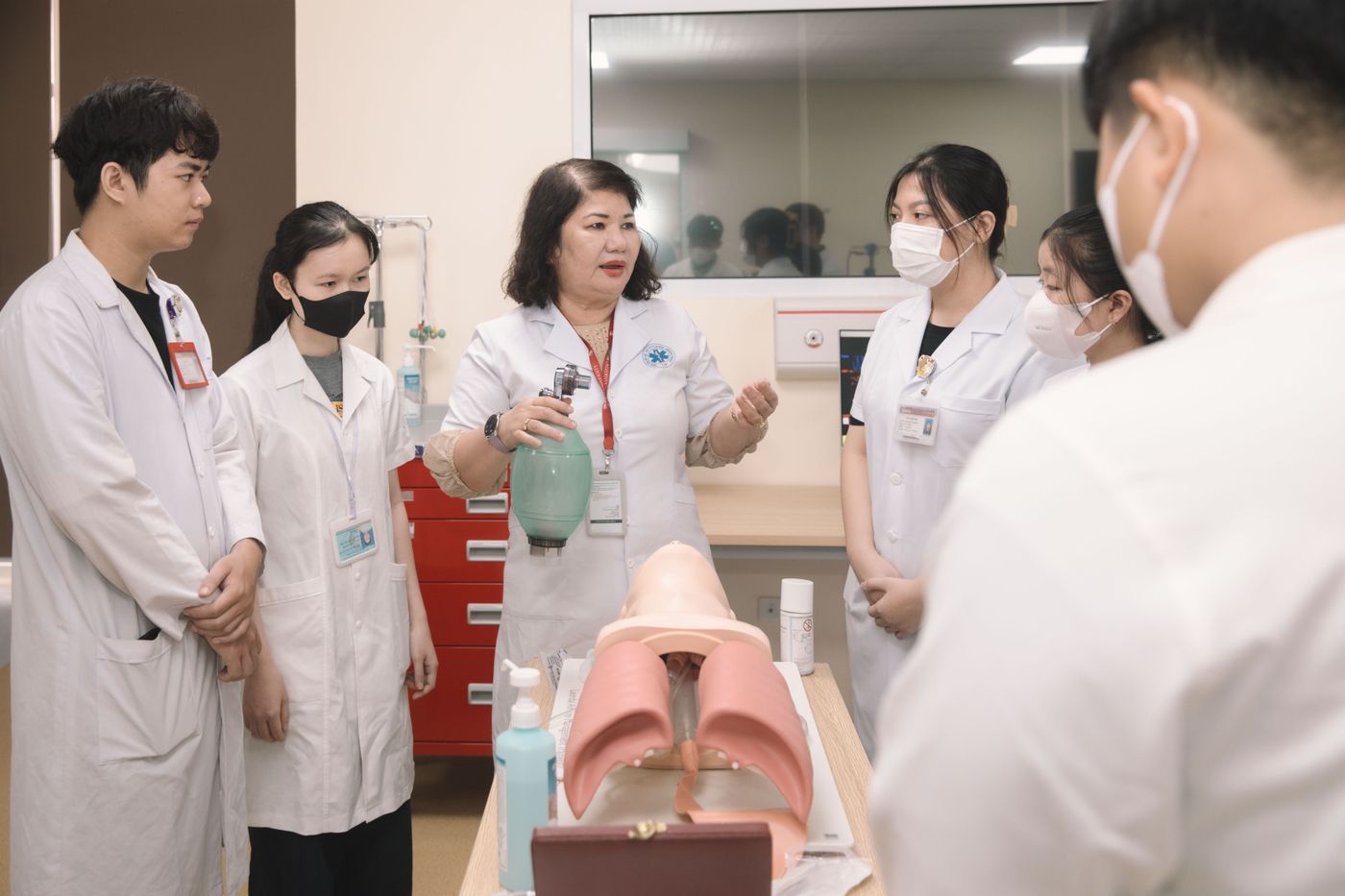
Mobile clinical training is a straightforward idea with consequences that are easy to underestimate. Instead of the learners traveling to a fixed classroom or skills lab, a qualified educator and the required equipment travel to the facility, and the training happens in the facility's own environment, on its own devices, against its own protocols.
The important word is environment. A generic course teaches the concept of central line care. An on-site session teaches it using the dressing kits your supply chain actually stocks, at the bedside layout your rooms actually have, following the policy your facility has adopted. That match between where a skill is learned and where it is performed is the difference between training that transfers to Monday morning and training that has to be re-learned when the nurse gets back.
Mobile training covers a wide span: annual skills validation, new equipment rollouts, unit-specific competencies, refresher days for returning staff, and onboarding cohorts for new graduates. What unites them is that the teaching comes to the work rather than pulling the worker away from it. If you want to see how this sits alongside classroom and cohort options, our mobile training service page lays out the formats side by side.
The test that separates the two models. Ask where the skill will be performed. If it is performed on your unit, on your equipment, then the closer the training happens to that unit and that equipment, the less is lost in translation. Distance is not neutral. It is a tax on transfer.
Neither model wins every time. Sending one or two people to an external course makes sense when the numbers are small, the content is generic, or the credential can only be issued at an accredited site. On-site training pulls ahead when four pressures show up together, and in a hospital they usually do.
Coverage. You cannot release ten nurses from a running unit at the same time. Send-out training forces you to stagger attendance across weeks, which stretches a one-day topic into a month of partial rollouts and inconsistent practice in between. An on-site educator can work in waves through a single shift, training small groups while the floor stays staffed.
Travel and windshield time. Every off-site seat carries hours that never appear on the invoice: the drive there and back, parking, and the dead time around the session. Multiply that by a cohort and it becomes real money, paid in the currency you are shortest of.
Backfill. A nurse in a classroom across town is not on the floor, and the floor still needs covering. That cover is often overtime or agency, frequently the single largest line in the true cost of training, even though it never appears on the quote.
Consistency. Send twenty nurses to four different sessions and you get four slightly different versions of the skill, taught by whoever was rostered that day. Train them together, on your protocol, and everyone leaves with the same standard. For competencies that feed patient safety, that uniformity is the whole point.
The clean way to see it is a break-even. Off-site cost scales per head, because each seat adds tuition, travel and backfill, while on-site is closer to a flat daily rate the cohort shares. Below a handful of learners, send-out is cheaper. Above a threshold, the on-site line sits under it and stays there.
The reason send-out training looks cheap is that its quote shows only one of its costs. A fair comparison puts every cost of both models on the same page, and when you do that, tuition is usually the smallest slice.
The larger slices are the ones that live in the staffing budget rather than the education budget, which is exactly why they are missed. Backfill for the absent nurse. Travel time paid at the nurse's rate. Overtime or agency premiums to hold the floor. And the softer cost of a partial rollout, where half the unit has the new skill and half does not, so practice is inconsistent until the last cohort finally goes.
On-site training does not make these costs vanish. Staff still step off the floor, and someone still has to hold their patients. What it removes is the travel entirely, and it compresses the backfill, because groups train in short waves rather than being lost for a whole day each. The educator's flat daily rate is then shared across everyone trained that day, so the per-head figure falls as the cohort grows.
Build the comparison honestly. Put four lines under each option: tuition, travel time, backfill cover, and rollout duration. The model with the lower tuition often loses on the other three. A quote that shows only tuition is not a price, it is a fragment of one.
The strongest argument for on-site training is also its hardest logistical problem: it happens on a live unit, and the unit still has patients. A provider who has not solved this in practice will disrupt care. The solution is staggered release, not mass release.
Instead of pulling a whole unit at once, you train in small waves. A group of three or four leaves the floor for a focused block, completes the station, and returns before the next group goes. The educator repeats the same station through the shift, so the content is identical for everyone while staffing on the floor never drops below a safe line.
Beyond scheduling, three practical things decide whether the day runs cleanly. Space: a quiet room or unused bay away from patient earshot, not a corridor. Equipment: the provider should bring manikins, task trainers and consumables, and train on the same device models your units use. Interruption: sessions must respect your infection-control policies and pause for genuine clinical need, because a training day that competes with patient care will lose, and should.
This is where simulation earns its place: a good on-site educator does not simply talk through a skill, they let staff practice it to the point of confidence. Our simulation-based sessions are built to run in exactly these short, repeatable waves rather than as one long lecture.
Mobile training is only as good as the people and process behind it, and the market ranges from serious clinical educators to vendors who mostly move slides. Six questions separate them.
Who actually teaches? Ask for the credentials of the person who will be in your building, not the company brochure. For clinical content you want an experienced clinician-educator, and for anything tied to nursing scope, a licensed nurse. The name on the quote is not always the person who shows up.
Will it be customized to us? A serious provider asks for your protocols, your equipment list and your competency requirements before the day, and builds the session around them. If the same deck is delivered everywhere, you are buying distance, not fit.
What comes with us, and what do we supply? Clarify the equipment split in writing. Who brings the manikins and consumables, what the facility provides, and what the room needs. Surprises here are what turn a training day into a scramble.
How is competency documented? Under The Joint Commission's human resources standards, facilities must be able to show that staff competence was assessed and validated, not merely that a class was attended. Ask what documentation you receive per learner and whether it maps to your competency framework.
How is effectiveness measured? The weakest programs measure attendance; better ones measure demonstrated skill at the station and confidence afterward. The INACSL Healthcare Simulation Standards of Best Practice set out how simulation-based competency should be structured and debriefed, and a credible provider can speak to that framework rather than to seat time.
Can they show references and a run sheet? Ask for facilities of a similar size and a sample plan for the day, including how they handle staggered release and a clinical interruption. A provider who has done this before will have a clear answer.
The one question that reveals the most. Ask a prospective provider how they keep a unit safely staffed while training on it. A real clinical educator answers with waves, census planning and a station that repeats. A vendor answers with a promise that it will be fine.
None of this makes send-out training wrong; it makes it situational. For one nurse pursuing a specialty certification that can only be granted at an accredited center, you send her out. For a facility-wide equipment rollout, an annual skills validation, or an onboarding cohort that must reach one standard on your protocols, the case for bringing the educator in strengthens with every added person and every mile of travel avoided.
The honest summary is that on-site training buys three things at once: no travel, backfill compressed into short waves, and a single standard taught on your own equipment. Whether those outweigh a lower tuition line is an arithmetic question you can answer for your own numbers before you commit. To see how mobile delivery maps against the classroom and cohort formats we run, compare them on our courses page, and read this alongside our wider guide to building a training program for your facility.
No, and a provider who claims it is has not done the arithmetic. For one or two learners, an external seat is usually cheaper, because you are not paying for an educator's whole day. On-site pulls ahead as the cohort grows, because the flat daily rate is shared across more people while travel and staggered backfill costs fall relative to a full off-site release. The right answer depends on your wage rates, your backfill difficulty and how far the external course is.
There is no universal number, but the mechanism is simple. Compare the on-site day rate against the total per-seat cost of sending people out, tuition plus travel plus backfill, multiplied by your cohort. The point where those two totals meet is your break-even, and for most facility-wide competencies and equipment rollouts it arrives well within a single unit's headcount.
Only if it is run badly. Done properly, training moves in small waves so the floor never drops below safe staffing, uses a quiet space away from patients, and pauses for genuine clinical need. The provider should treat patient care as the priority that always wins. Ask specifically how they keep the unit staffed during the session.
It should, if the provider documents demonstrated competency per learner rather than just attendance. The Joint Commission's human resources standards expect facilities to assess and validate staff competence, so ask what record you receive for each person and confirm it maps to your competency framework. Documentation you can file is part of what you are buying.
Yes, and equipment rollouts are one of its strongest uses. Because the educator trains on your device models in your environment, staff practice on the exact pump, monitor or system they will use at the bedside. That avoids the gap that opens when people train on a different model off-site and meet yours for the first time on a live patient.
If you are weighing a facility-wide competency, an equipment rollout, or an onboarding cohort, the fastest way to a real answer is to price it against your own numbers. We build mobile clinical training around your protocols, equipment and schedule, and run it in waves that keep your unit staffed.
General guidance only
This article is published by Wahero Health Institute as general guidance for healthcare facilities and employers evaluating training options. Cost figures in the charts are illustrative, and the right choice depends on your own wage rates, staffing and protocols. It is not a fixed quotation or a substitute for a scoped proposal. See our Terms of Use.