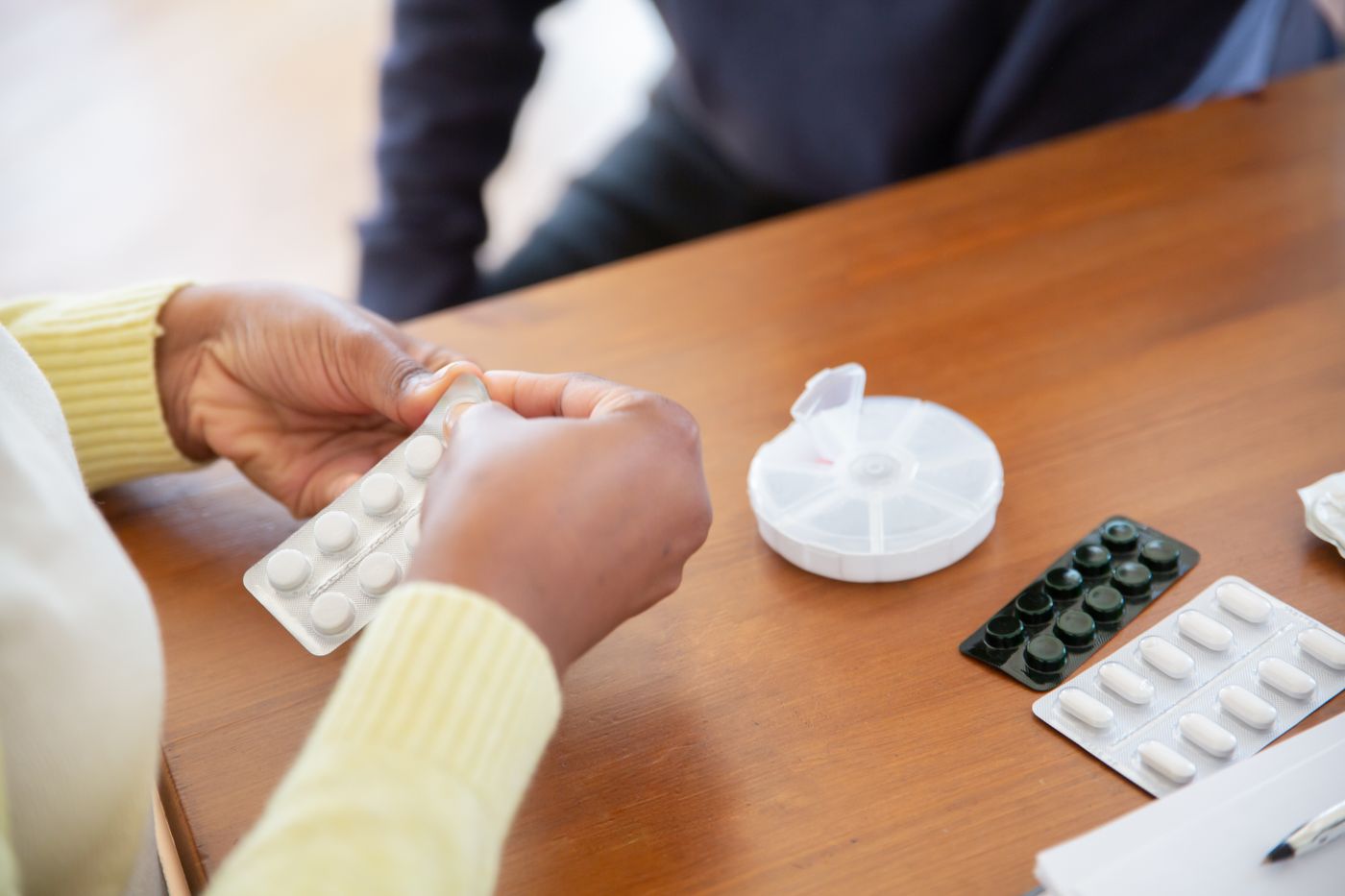
Photo: Kampus Production via Pexels
A patient arrives on the unit at four in the afternoon with a medication list from the emergency department, a printout from a primary care visit eight months ago, a bag of bottles from home, and a daughter who says one of the pills was stopped in March. None of the four sources agrees with the others. The admission orders were written from the first one.
That scene is medication reconciliation as it actually presents, and it is why the process is a named accreditation requirement rather than a courtesy. Research on hospital admissions has repeatedly found that more than half of patients on several regular medicines arrive with at least one unintended discrepancy between what they take and what is ordered, and that the most common discrepancy is a medicine that was simply left off.
What follows contains no guidance about any drug and no clinical decision. The subject is the process, what The Joint Commission requires of it, and how nurses are assessed on it.
Medication reconciliation in accredited US hospitals has for years been governed by National Patient Safety Goal NPSG.03.06.01, titled "Maintain and communicate accurate patient medication information." For 2026 The Joint Commission reorganized its hospital accreditation manual, renamed the National Patient Safety Goals as National Performance Goals, and renumbered this requirement as NPG.14.05.01 in the hospital program effective January 2026. The title and substance carried over; expect to hear both numbers.
The 2026 hospital requirement has five elements of performance. The hospital obtains information on the medications the patient is currently taking, scheduled and as needed, and documents it in a list useful to those who manage medications. It compares the information the patient brought with the medications the hospital orders, to identify and resolve discrepancies, and a qualified individual identified by the hospital does that comparison. It gives the patient written information on the medications they should be taking at discharge, and explains why managing that information matters.
Two details matter for nurses. The requirement names the discrepancy types it expects to be caught: omissions, duplications, contraindications, unclear information and changes. And it acknowledges that complete information is often hard to get, stating that a good faith effort to obtain it from the patient and other sources meets the intent. Good faith is a standard of effort, documented. It is not a license to accept the first list offered.
The Joint Commission introduced medication reconciliation as a National Patient Safety Goal in 2005, as Goal 8, with detailed requirements across care settings. Organizations found it too prescriptive to apply consistently, and from January 2009 The Joint Commission stopped counting survey findings on it toward accreditation decisions while a revised goal was written. The replacement, NPSG.03.06.01, was finalized in December 2010 and took effect on July 1, 2011. The 2005 goal tried to specify the process; the 2011 goal specifies the outcome and leaves the process to the organization, which is why who does each part varies between facilities and why your own policy is the document to learn.
Printable study guide
Get the printable Medication Administration Skills study guide
A twelve-page simple study guide to medication administration skills from Wahero Health Institute. Reconciliation is the front end of safe administration; the guide covers the skills that follow it, in a plain printable format for competency days and orientation binders.
Medication Administration Skills, $12.99
Pay by Cash App, PayPal or Zelle at checkout; the download link is emailed once the payment is confirmed, usually the same day. Study material only: it does not replace the Board's requirements, your employer's policies or the judgment of a licensed clinician.
Obtain. The history is gathered from the patient or caregiver and from other sources such as pharmacy fill records, a discharge summary or the bottles the patient brought. The Agency for Healthcare Research and Quality's MATCH toolkit, Medications at Transitions and Clinical Handoffs, published in 2012 and developed at Northwestern Memorial Hospital in collaboration with The Joint Commission, recommends a single documented home medication list as the "one source of truth" that every discipline works from.
Compare. The list is set against the orders at each transition: admission, transfer between levels of care, and discharge. The Joint Commission says a qualified individual identified by the hospital does the comparison, and a nurse is expected to know which role that is where they work.
Resolve. A discrepancy is not an error until it is classified. Some are intentional changes a prescriber made and did not document; some are unintentional. The resolution is a prescriber's decision, communicated and recorded. The nurse's part is to surface the discrepancy, state it precisely, and escalate it through the route the facility defines.
Communicate. At discharge the reconciled list goes to the patient in writing, and by policy to the next provider. The administration skills that follow reconciliation are collected in our twelve-page printable Medication Administration Skills study guide, written for orientation binders and competency days.
Discrepancies cluster at transitions of care, where one list is rewritten as another by someone who was not there for the first. Cornish and colleagues, in a study published in the Archives of Internal Medicine in 2005, compared admission orders with an interview-based medication history for 151 patients on at least four regular prescription medicines. Eighty-one of them, 53.6 percent, had at least one unintended discrepancy. The most common error, at 46.4 percent of discrepancies, was omission of a regularly used medication, and the authors judged 38.6 percent of discrepancies to have the potential to cause moderate to severe discomfort or clinical deterioration.
In the same year Tam and colleagues published a systematic review in the Canadian Medical Association Journal covering 22 studies and 3,755 patients: errors in prescription medication histories at admission occurred in up to 67 percent of cases. The figures vary with the method used to find them, which is itself a lesson: the more systematic the history, the more discrepancies it finds.
The term competency programs use for the first stage done well is the best possible medication history, or BPMH. ISMP Canada, which developed the concept, defines it as a history obtained through a systematic interview with the patient or caregiver and verified against at least one other reliable source, covering all of the patient's medication use, prescribed and non-prescribed, with name, dose, route and frequency recorded. The World Health Organization adopted it in its High 5s implementation guide, "Assuring Medication Accuracy at Transitions in Care."
The largest recent test of this approach in US hospitals was MARQUIS2, the second Multi-Center Medication Reconciliation Quality Improvement Study, run at 18 North American hospitals or hospital systems between 2016 and 2018 and published in BMJ Quality & Safety in 2022 by Schnipper and colleagues. Sites implemented a toolkit of 17 system-level and 6 patient-level interventions with physician mentoring, and unintentional discrepancies per patient fell significantly over time.
What a BPMH asks of the interviewer is structure: ISMP Canada's interview guide organizes the conversation around prompts for the things patients forget to mention, such as over-the-counter products, supplements and medicines that are not tablets. The second source is not optional. A history with one source is a routine history, whatever the form calls it.
What makes a history "best possible". Not that it is long, and not that it is perfect. That it was taken systematically, that at least one second source was checked and named, and that the gaps were recorded as gaps rather than filled with guesses.
The barriers are consistent across settings and mostly structural. Time is the first: a thorough history takes longer than the slot an admission workflow allows, and the pressure is to accept the list that came with the patient. Sources are the second: pharmacy records are incomplete when a patient uses more than one pharmacy, and outside records are not always reachable at two in the morning. Patient memory and health literacy are the third, which is why the interview needs prompts rather than a single open question. Role ambiguity completes the set: when nursing, pharmacy and medicine each assume another discipline has done the history, nobody has. AHRQ's MATCH toolkit begins with leadership support and process mapping because the failure is usually a process gap rather than an individual lapse. The one barrier that is not structural is reading "good faith" as "good enough".
Facilities assess this skill because accreditation standards require them to assess and document staff competence, and because it decays quietly: the shortcuts that creep in produce no immediate feedback. A validation session is usually a simulated admission with a set of sources that deliberately disagree. The assessor watches for the following.
What fails a session is as instructive as what passes it: accepting the emergency department list as the history, writing "per patient" with no second source attempted, correcting the list quietly without a prescriber's decision, discharging a simulated patient without the written list. None of these involves a drug decision, which is why the competency can be assessed without testing clinical judgment. Our article on preventing medication errors places reconciliation inside the wider system of checks that surround administration.
The assessor's one-line summary. A competent reconciliation can be reconstructed by someone who was not there: which sources, which discrepancies, who resolved them, and what the patient was handed.
Educational use. This article is learning material for nurses and nursing students. It is not clinical advice, and it does not replace your employer's policies, your facility's protocols, or the judgement of a licensed clinician. Always follow the standards and procedures in force where you practise.
Is medication reconciliation a nursing responsibility or a pharmacy responsibility? Both, and the split is set locally. The Joint Commission's requirement says the comparison is done by a qualified individual identified by the hospital, and leaves the hospital to decide who that is. Your policy answers this for your unit.
What counts as a good faith effort to obtain a medication list? The Joint Commission's wording states that a good faith effort to obtain the information from the patient and other sources meets the intent of the requirement. Assessors read that as a standard of effort that is documented: a structured interview, at least one second source attempted and named, and the gaps recorded as gaps.
Did The Joint Commission drop the medication reconciliation goal in 2026? No. For 2026 the hospital program renamed its National Patient Safety Goals as National Performance Goals and renumbered them, so NPSG.03.06.01 now appears as NPG.14.05.01 in the hospital manual. The title and the five elements of performance carried over.
Our Medication Safety and Dosage Calculation course treats reconciliation as the front end of safe administration and assesses it under observation. For facilities, we run reconciliation competency validation on site against your own policy; see our facility training and competency services.
Related reading
Educational content only
This material is published by Wahero Health Institute for professional education and is not individual medical advice, a care protocol, or a substitute for clinical judgment. Always follow your facility's policies, your state's nurse practice act, and your own scope of practice, and confirm medication doses against a current authoritative reference before administration. See our Terms of Use.
